
A hidden camera can be difficult to notice in a rental room, changing area, or unfamiliar office. A tiny lens may reflect a desk lamp, while a wireless device may leave no obvious mark. In 2026, buyers have more options, from basic lens-finding tools to multi-signal detection devices. But a higher price does not guarantee better results. A Spy Camera Detector can support a careful privacy check; it cannot promise that every device will be found.
This guide explains what buyers should examine before choosing one: detection methods, practical range, ease of use, battery life, and clear instructions. Some products use radio-frequency signals, while others help locate reflective lenses. Each method has limits. A detector may react to ordinary electronics, and a quiet room is not proof of privacy. That matters. Look for specific test details, realistic claims, and a return policy rather than dramatic marketing language. Also consider how comfortable the device feels in your hand and whether its display is readable under dim lighting. Small details count.
Use any detector responsibly and respect other people’s privacy. Follow the product manual, avoid disturbing property, and contact the appropriate manager or authorities if you find something concerning. No gadget replaces judgment. This review aims to help readers compare options with care, not feed fear. And, honestly, product claims can be hard to verify without independent testing, so buyers should keep a little skepticism.
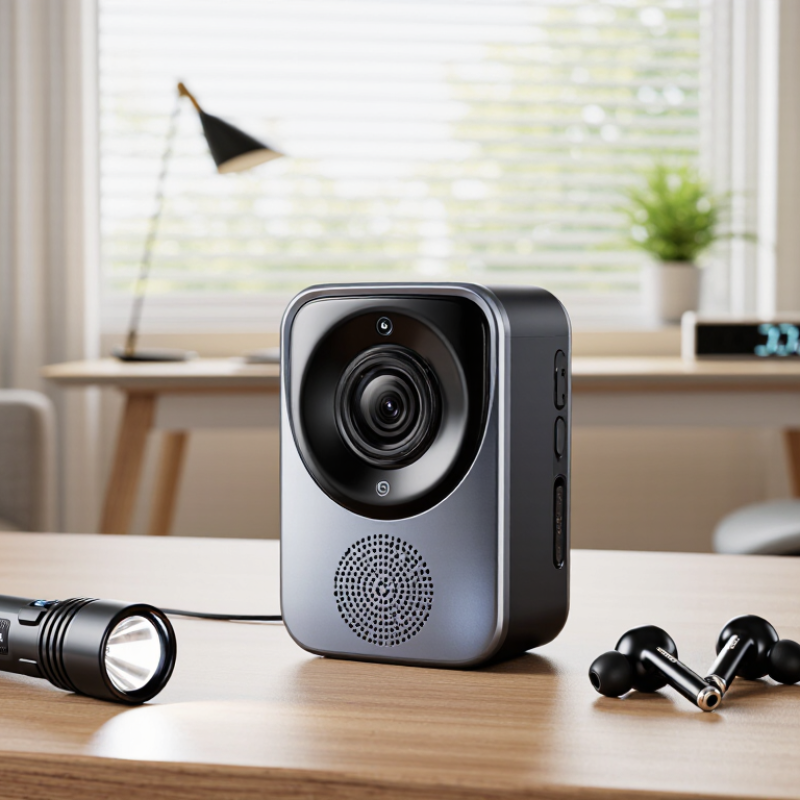
Hidden-camera detectors usually combine radio-frequency scanning, optical lens finding, and network analysis. Each method reveals a different clue. An RF detector measures nearby wireless transmissions from cameras sending video over Wi-Fi or cellular networks. It may show stronger signals near a wall socket, smoke alarm, or desk ornament. However, phones, routers, and smart appliances can create false alerts.
An optical detector uses bright LEDs to search for lens reflections. Through a small viewfinder, a camera lens may appear as a sharp white or red pinpoint, even in a dim room. Some devices also scan infrared light, which certain night-vision cameras use. Network scanners identify unfamiliar devices connected to the same router. That sounds precise, but locally recording cameras may transmit nothing.
Market growth explains the concern. MarketsandMarkets’ 2024 Video Surveillance Market report projects growth from approximately $53.7 billion in 2024 to $83.3 billion by 2029. Grand View Research also forecasts strong expansion in smart-home technology through 2030. More connected devices mean more confusing signals.
No detector is magic. A careful inspection still matters. Check unusual holes, warm adapters, loose fixtures, and objects facing beds or changing areas. Test during daytime and again with lights off. I have found that moving slowly works better than trusting one sudden beep. False alarms happen. They deserve a second look.
Types of Detectors Available in 2026
Hidden-camera detection now uses several technologies, and each reveals different evidence. Radio-frequency detectors scan for wireless transmissions from active cameras, microphones, or transmitters. They work best in quiet rooms, but nearby Wi-Fi devices can create false alerts. Some models also measure signal strength, helping users trace a source behind furniture or inside a wall.
Optical lens finders use bright LEDs and a viewing filter to expose reflections from camera lenses. In a dark hotel room, a tiny lens may appear as a sharp red glint. They cannot reliably detect covered, inactive, or non-reflective lenses. Magnetic-field detectors identify certain electronic components, while thermal cameras can show heat from powered devices. These tools are useful, but heat can also come from chargers, lamps, or ventilation systems.
Combination detectors are becoming more practical. A 2024 Grand View Research report valued the global video surveillance market at about 83.99 billion dollars in 2023, showing how widely imaging technology is deployed. A 2024 MarketsandMarkets analysis also forecast continued growth in RF test equipment, driven by connected devices and wireless networks. Those figures describe wider security markets, not detector accuracy. That distinction matters. Professional testing should include a visual inspection, RF scanning, and lens checking. No detector sees everything. Cheap devices may look convincing, yet calibration, room conditions, and user experience can change the result. My own concern is simple: buyers often trust a flashing light too quickly.
| Detector Type | Primary Detection Principle | What It Can Detect | Typical Practical Range | Best Use Case | Important Limitations | Key Buying Features |
|---|---|---|---|---|---|---|
| RF Signal Detector | Measures radio-frequency energy transmitted by wireless devices. | Active Wi-Fi, cellular, Bluetooth, analog-radio, and other radio-transmitting cameras. | Approximately 1–10 m in ordinary indoor conditions; distance varies substantially with transmitter power, walls, and interference. | Checking hotel rooms, meeting rooms, vehicles, and offices for actively transmitting wireless devices. | Usually cannot identify a camera that is powered off, recording locally, or connected only by cable. Nearby routers and phones may trigger alerts. | Adjustable sensitivity, frequency coverage, signal-strength display, vibration mode, and false-alarm filtering. |
| Optical Lens Finder | Uses visible or near-infrared illumination to reveal reflections from camera lenses. | Small camera lenses, including many hidden pinhole lenses, when the viewing angle and lighting conditions are suitable. | Commonly about 0.5–5 m for clear visual identification; effective distance depends on lens size, ambient light, and user positioning. | Inspecting smoke detectors, clocks, vents, chargers, mirrors, decorations, and other objects with a direct line of sight. | It does not prove that a detected reflection is a camera. Dust, glass, polished surfaces, and bright light can create misleading reflections. | Multiple illumination modes, a viewfinder or filter, adjustable brightness, compact design, and a wide viewing angle. |
| Infrared Light Detector | Detects infrared illumination emitted by or reflected from night-vision systems. | Some cameras using infrared LEDs for operation in darkness. | Often within approximately 1–5 m, depending on infrared output, wavelength, and the detector’s sensitivity. | Dark-room inspections and checks for night-vision cameras that use active infrared lighting. | It may not detect cameras with no infrared illumination, and ordinary infrared remote controls or electronic devices can also produce signals. | Infrared sensitivity around common night-vision wavelengths, optical filtering, low-light viewing, and manual or automatic gain control. |
| Magnetic Field Detector | Detects changes in magnetic fields caused by magnets or magnetic switches. | Magnetic mounts, magnetic contacts, and some GPS or tracking devices that use a noticeable magnet. | Typically a few centimeters to roughly 10 cm, depending on magnet strength and sensor sensitivity. | Searching vehicle interiors, furniture, door frames, and metal surfaces for magnetically attached devices. | It does not detect most cameras by itself and may respond to speakers, motors, tools, or other magnetic components. | Audible and vibration alerts, sensitivity adjustment, small probe size, and a clearly calibrated indicator. |
| Non-Linear Junction Detector | Transmits radio energy and analyzes harmonic responses from semiconductor junctions. | Electronic circuits, including powered or unpowered devices containing semiconductors. | Professional equipment may detect objects from several centimeters to around 1 m, depending on antenna design, material, and surroundings. | Professional security inspections where a hidden electronic device may be inactive or shielded from ordinary RF scanning. | High cost, specialized operation, possible false alarms from normal electronics, and generally unsuitable for casual home use. | Operator training support, harmonic discrimination, stable output control, directional antenna, and interference management. |
| Wired-Camera Inspection Tool | Combines visual inspection with cable tracing, continuity testing, or network and power-line analysis. | Some cameras connected by coaxial cable, Ethernet, USB, or dedicated power wiring. | Usually limited by cable length, access to the wiring, and the tool’s test capability rather than by open-air distance. | Buildings, offices, vehicles, and installations where cameras may be connected to a local recorder or wired network. | It may require access to outlets, network equipment, junction boxes, or exposed wiring. It cannot reliably locate every concealed cable. | Coaxial and Ethernet compatibility, cable tracing, voltage testing, network discovery, and safe low-voltage operation. |
| Multi-Mode Detector | Combines two or more methods, commonly RF scanning, lens reflection detection, infrared detection, and magnetic sensing. | Wireless transmitters, visible lenses, infrared night-vision lights, and selected magnetically mounted devices. | Each mode has its own effective range; combining modes improves coverage but does not eliminate blind spots. | General-purpose personal inspections where the camera type and operating state are unknown. | More features can increase false alerts, battery consumption, device size, and user confusion if controls are poorly designed. | Independent mode controls, sensitivity adjustment, signal history, rechargeable battery, clear alerts, and a detailed user manual. |
Buyer note: No single detector can reliably find every hidden camera. For a more complete inspection, combine a visual search with optical lens detection, RF scanning, and—where appropriate—wired or magnetic checks. Always verify alerts because ordinary electronics, reflective surfaces, and wireless networks can produce false positives.
Before buying a spy camera detector in 2026, compare how it finds threats.
Radio-frequency scanning can identify wireless transmitters, while lens reflection tools help locate inactive cameras. Magnetic sensors may detect nearby metal, but they can also react to furniture, wiring, or appliances. No single method is reliable everywhere.
The 2024 Verizon Data Breach Investigations Report analyzed 30,458 security incidents and found human involvement in 68% of breaches. That finding supports a practical feature: simple operation. Choose a detector with clear alerts, adjustable sensitivity, and a readable display. Test it in a quiet room, then repeat the test near Wi-Fi routers and Bluetooth devices. False alarms are common.
Battery life and frequency coverage also deserve close attention. A short battery may fail during a full hotel-room inspection. A narrow frequency range can miss newer wireless equipment. Look for coverage details, not vague claims. The 2024 ENISA Threat Landscape report highlights growing exposure from connected devices, reinforcing the value of regular checks. App permissions matter too. An inexpensive detector may collect more data than expected. That part is easy to overlook.
A reliable camera detector needs testing beyond a product page. Begin in a familiar room with the detector fully charged. Record the normal radio environment before adding any test device. Wi-Fi routers, smart speakers, and nearby phones can create false alerts. Keep notes. That baseline matters.
Test it in daylight, low light, and complete darkness. Slowly scan lamps, vents, smoke alarms, picture frames, and glossy decorations. Hold the detector at different angles because lens reflections change with distance.
A small flashlight can reveal reflective glass, but reflections do not prove a camera exists. Confirm suspicious points with visual inspection and a second method.
Try the detector near active wireless equipment, then move it several meters away. Notice whether the alert weakens, stays constant, or disappears. Experienced testers repeat each check from the same position. They also test behind curtains and around furniture, where signals and reflections behave differently. Do not trust one loud beep.
Real rooms are messy. Human movement, walls, and electronic noise affect results. I once treated a persistent signal as important, but it came from a nearby household device. That mistake changed my testing routine. Detector readings should support careful observation, not replace it. Choose equipment with clear sensitivity controls, understandable instructions, and documented testing procedures. Independent reviews and return policies add useful protection when performance seems inconsistent.
A spy camera detector can support a privacy check, but it is not proof of safety. Optical scanners may miss covered lenses, while radio-frequency tools can react to routers, phones, or crowded Wi-Fi spaces. Test the device in a quiet room first. Then inspect smoke detectors, clocks, vents, chargers, and unusual holes at eye level. Small details matter. False alarms happen.
Privacy protection also depends on human behavior. Verizon’s 2024 Data Breach Investigations Report examined 30,458 incidents and found that the human element appeared in 68% of breaches. That figure concerns broader cybersecurity, yet it highlights a practical weakness: careless handling can expose sensitive findings. Store detector results securely, avoid photographing private areas unnecessarily, and limit access to trusted people. A detector should not become another privacy risk.
Legal duties vary by location, property type, and recording method. The U.S. Federal Trade Commission’s 2023 Consumer Sentinel Network Data Book recorded more than 2.6 million fraud reports, showing how quickly personal information can become part of a wider dispute. Do not remove equipment or enter restricted areas. Document the location from a safe position, notify the property owner or manager, and contact local authorities when appropriate. Laws may require consent for audio recording, even where video rules differ. I may overtrust technical readings sometimes; professional inspection and local legal advice remain important when the situation feels uncertain.
How to read this chart: It compares the approximate frequency span of selected wireless bands—not the number of cameras or a detector’s performance. Bands overlap, and permitted frequencies vary by country. An RF detector may miss a camera that is wired, switched off, or not transmitting. Follow local privacy laws and report suspected hidden cameras to the property manager or relevant authorities rather than tampering with them.
The 5 GHz Wi-Fi span is approximate; the 6 GHz range shown is the U.S. allocation. Actual device support varies by region.
