
Choosing Stainless Steel Meat Hooks for 2026 is not just about a polished finish. Buyers need hooks that carry expected loads, resist corrosion, and clean easily after repeated use. Small details matter: a smooth weld, a securely closed eye, and a point that holds without wobbling. Still, no single hook suits every rail, carcass size, or workflow.
The USDA’s 2024 Livestock Slaughter Annual Summary reports approximately 53 billion pounds of U.S. commercial red meat production. That figure describes the scale of processing, not the meat-hook market. It does, however, underline why dependable equipment and consistent maintenance matter in busy facilities. A hook’s material grade, wire diameter, working-load guidance, and finish deserve closer inspection than its appearance alone.
For an expert perspective, Temple Grandin is a respected authority on livestock handling and facility design, though not specifically on meat hooks. Her published guidance emphasizes designing equipment around animal movement and practical handling. That is a paraphrase, not a hook-specific quotation; I could not verify a direct quote from her about Stainless Steel Meat Hooks. This distinction matters. Buyers should also check manufacturers’ product specifications rather than assume every stainless hook offers the same strength or corrosion resistance. In this guide, we compare practical selection criteria for 2026, including construction, load information, cleaning needs, and value. Some product listings leave important details unclear. That deserves scrutiny, not guesswork.
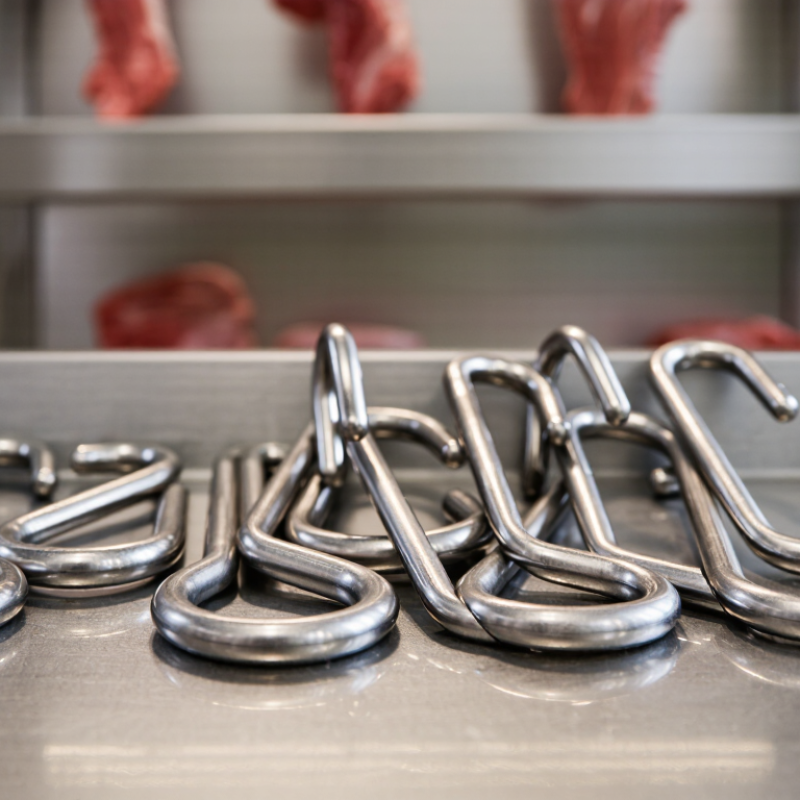
Stainless steel meat hooks are sturdy tools used to lift, hang, and move cuts of meat during preparation, cooling, or smoking. Their curved points catch securely, while the opposite end often has a loop for a rail or rack. Hook shapes and sizes vary, so match the tool to the cut and the support system. Small details matter.
Some hooks are made from stainless steel grades that resist rust better than others, but stainless steel is not rust-proof. Inspect the hook for cracks, rough welds, sharp burrs, or bending before use. A damaged hook can slip or become difficult to clean. Follow the maker’s load guidance, and never assume a thicker-looking hook can carry more weight.
Tips: Wash hooks with hot water and suitable detergent after use, then rinse and dry them fully. Check joints and curves for trapped residue. I sometimes overlook the loop during cleaning; it deserves the same attention as the point. Keep clean hooks separate from used ones, and store them where they cannot fall or puncture nearby items.
For a 2026 meat hook, steel grade matters more than a mirror finish. ASTM A240/A240M lists Type 304 with 18–20% chromium and 8–10.5% nickel. It suits many clean, damp processing areas and resists routine corrosion. Type 316 contains 2–3% molybdenum, which improves resistance to chloride exposure. That matters near salty brines or frequent washdowns. Still, 316 is not automatically the best choice; cleaning practices and exposure determine whether its added alloy content is worthwhile. Check the material certificate, not just a seller’s “food-grade” claim.
Hook shape affects handling and load stability. A broad, smooth throat can reduce pressure marks, while a narrow point may penetrate firmly but tear softer cuts. Choose a shank thick enough for the expected load, with a rounded tip and no burrs or crevices around the weld. Check the welds. Poor finishing can trap residue and make inspection harder, even when the steel grade is suitable. For overhead rails, verify the hook’s rated capacity and inspect for bending, cracks, and corrosion before use. ASTM chemistry data helps compare grades, but it cannot confirm workmanship or safe loading. A little caution is warranted.
Typical minimum tensile strength by stainless steel grade (MPa)
Grades 304 and 316 have a typical minimum tensile strength of 515 MPa; grades 430 and 410, 450 MPa. These are typical minimums for annealed flat-rolled products, not load ratings for finished hooks. For meat handling, consider corrosion exposure as well as strength: 304 is a common general-purpose choice, while 316 is often preferred where exposure to salts or chlorides is a concern. Choose a smooth, securely formed hook design suited to the meat and handling method; verify the finished hook’s rated load with its supplier.
When comparing stainless steel meat hooks, separate the steel’s strength from the hook’s rated capacity. ASTM A240/A240M lists a minimum tensile strength of 515 MPa for annealed Type 304 plate and sheet. That figure does not rate a finished hook: wire diameter, bend radius, welds, and surface defects also affect performance. Look for a clearly stated working load and evidence that the complete hook was tested, not just a material certificate. Leave a margin below the rating, especially when loads swing or hang from one point. A neat-looking weld is not proof of capacity.
Size should match the product and the rack spacing. A short hook may crowd a large cut; a long one can sway and strike nearby equipment. Check the throat opening, tip shape, wire thickness, and clearance with a real load, not a catalog image. Finish matters during cleaning. EHEDG hygienic-design guidance emphasizes smooth, accessible surfaces that can be cleaned effectively; inspect bends and welds for pits, burrs, and residue-trapping creases. A polished surface helps, but it cannot compensate for poor geometry. For wet, salty processing areas, confirm the grade and care instructions rather than assuming every “stainless” hook resists corrosion equally. I would still want a documented load test. The label alone feels thin.
What Are the Best Stainless Steel Meat Hooks for 2026?
Which Meat Hooks Suit Different Butchering and Smoking Tasks
The right hook depends on the cut, the work surface, and how the meat will hang. For breaking down larger cuts, a sturdy J-hook can provide a secure grip through a thick section of meat. A narrower hook may suit smaller cuts, but thin points can tear delicate tissue. Check the hook’s rated capacity and inspect its tip and welds before use. A smooth finish is easier to clean.
Smoking calls for different priorities. Straight or gently curved hooks can help separate smaller pieces, leaving space for smoke to circulate. For heavier cuts, choose a thicker hook designed for the load; appearance alone is not enough. Keep meat from touching other pieces or the smoker walls. Small spacing changes can matter.
Stainless steel resists corrosion, but it still needs care. Wash hooks promptly, rinse away cleaning residue, and dry them fully before storage. Food-contact suitability and safe working loads should be confirmed with the supplier, since steel grade and construction vary. I used to assume all polished hooks cleaned equally well. That is not always true. Check crevices, bends, and joints by hand.
| Hook Style | Typical Size Range | Best-Suited Tasks | Useful Design Features | Buying and Use Notes |
|---|---|---|---|---|
| Stainless Steel S-Hook | About 4–8 in (10–20 cm) long; wire diameter commonly about 3–6 mm | Hanging sausages, smaller cuts, or food from a compatible rail or rack in a smoker | Two open ends make it easy to attach and reposition items; compact shape stores easily | Choose a size that fits the rack and the food. Check the manufacturer’s load rating, and avoid overloading or using a hook that can slip off its support. |
| Meat Gambrel | Commonly about 12–18 in (30–46 cm) wide; exact dimensions vary by model | Suspending a dressed deer, hog, or other carcass during processing | Wide crossbar spreads the hanging points; tapered ends are designed to engage the hind legs | Match the span and rated capacity to the animal and suspension setup. Use a stable hoist or support and follow safe handling procedures. |
| Single-Point Butcher Hook | Typically about 4–8 in (10–20 cm) long, with size and wire thickness varying by intended load | Handling or hanging individual primal cuts and larger portions during butchering | A pointed end penetrates tissue; a curved end or eye can connect to a rail or other support, depending on the design | Select the point and curve for the cut and hanging method. Keep the point protected in storage and clean it carefully after use. |
| Double-Prong Meat Hook | Often about 5–8 in (13–20 cm) long; prong spacing differs by design | Turning, lifting, or holding larger cuts such as shoulders and roasts during processing | Two points can help stabilize a cut and reduce rotation compared with a single-point hook | Use only where the prongs can be inserted securely. A double-prong design does not automatically have a higher load rating than a single hook. |
| Small Sausage or Bacon Hanger | Individual hooks are often about 3–6 in (8–15 cm) long; multi-hook bars vary in width | Hanging links, small sausage chubs, or bacon pieces with a loop or suitable hanging point | Multiple hooks or closely spaced bends help organize smaller items in a smokehouse or curing space | Leave enough space between pieces for airflow and smoke circulation. Confirm that the hanger fits the rack and can be cleaned thoroughly. |
| Poultry Hanging Hook | Commonly about 4–7 in (10–18 cm) long; shape and opening vary | Suspending whole poultry by a suitable leg or cavity position in a smoker | Curved or paired contact points help keep the bird in position during hanging | Use a hook shaped for the bird and support method. Ensure the poultry is secure and does not touch other food or smoker surfaces. |
| Stainless Steel Fish-Hanging Hook | Often about 3–6 in (8–15 cm) long; smaller forms are used for lighter fish | Hanging fish for smoking or drying when the fish can be supported safely | A narrow curved point can suit smaller hanging openings; some designs include a loop for rack attachment | Choose a hook appropriate to the fish’s size and texture. Delicate flesh may tear, so use a suitable hanging point and keep the hook within its rated load. |
| Stainless Steel Grade and Finish | Common choices include 304 stainless steel; 316 stainless steel is also available | General food-preparation environments; 316 may be considered where exposure to salts or chlorides is a concern | Smooth, accessible surfaces are easier to inspect and clean; welded joints should be free of crevices and rough burrs | Confirm the stated alloy and care instructions with the seller. Stainless steel is corrosion-resistant, not corrosion-proof; clean, rinse, and dry hooks after use. |
What Are the Best Stainless Steel Meat Hooks for 2026?
How to Clean, Inspect, and Store Meat Hooks Safely
Safe handling starts before a hook touches meat. Wash hooks with hot water and detergent, paying attention to the curve, point, and welded joints. Rinse, then apply a food-contact sanitizer according to its label. Respect the stated concentration and contact time. Let hooks air-dry fully; damp hooks can develop spots, even when made from stainless steel. The FDA Food Code 2022 calls for food-contact surfaces used continuously with temperature-controlled foods to be cleaned at least every four hours.
Inspect each hook under bright light. Look for bent points, rough welds, pits, rust-colored marks, or cracks that can trap residue. A rough edge is easy to miss. Run a clean cloth over the surface; snagging fibers may reveal damage your eyes overlook. Retire hooks that cannot be cleaned effectively, and follow the equipment maker’s care instructions. Stainless steel is corrosion-resistant, not corrosion-proof.
Store clean, dry hooks in a covered, ventilated area, separated so points cannot scratch other tools or hands. CDC’s 2011 foodborne-illness estimates attribute about 48 million illnesses, 128,000 hospitalizations, and 3,000 deaths to foodborne agents annually in the United States. Those figures cover many causes, not meat hooks specifically, but they show why small sanitation steps matter. Keep a simple inspection log. I still find that easy to forget on a busy shift.
