
What Are the Best Trimless Spotlights from China?
Choosing the best Trimless Spotlights from China takes more than comparing catalogue photos. A seamless plaster finish can look elegant, yet poor heat management or imprecise installation may leave visible gaps. The International Energy Agency’s 2023 Energy Efficiency report notes that lighting represents roughly 15% of global electricity consumption. That broader figure is not a product test, but it explains why efficacy and optical performance deserve attention alongside appearance.
Lighting designer Richard Kelly is often credited with the line, “Light is the magic ingredient that makes or breaks a space.” It suits trimless fixtures: a narrow beam can sharpen a kitchen counter, while glare from an exposed LED can spoil a quiet ceiling. The fixture matters. So does the room, the dimmer, and the installer’s skill.
When comparing Chinese suppliers, ask for measured beam angles, CRI data, lumen output, driver specifications, and clear cut-out dimensions. Check whether the plaster-in frame suits the ceiling system and whether replacement drivers are available. Product sheets help, but they do not reveal everything; finish quality and color consistency can vary between batches. Small details matter. A “best” choice is therefore one supported by verifiable test data, realistic samples, and responsive technical support—not the boldest claim on a sales page.
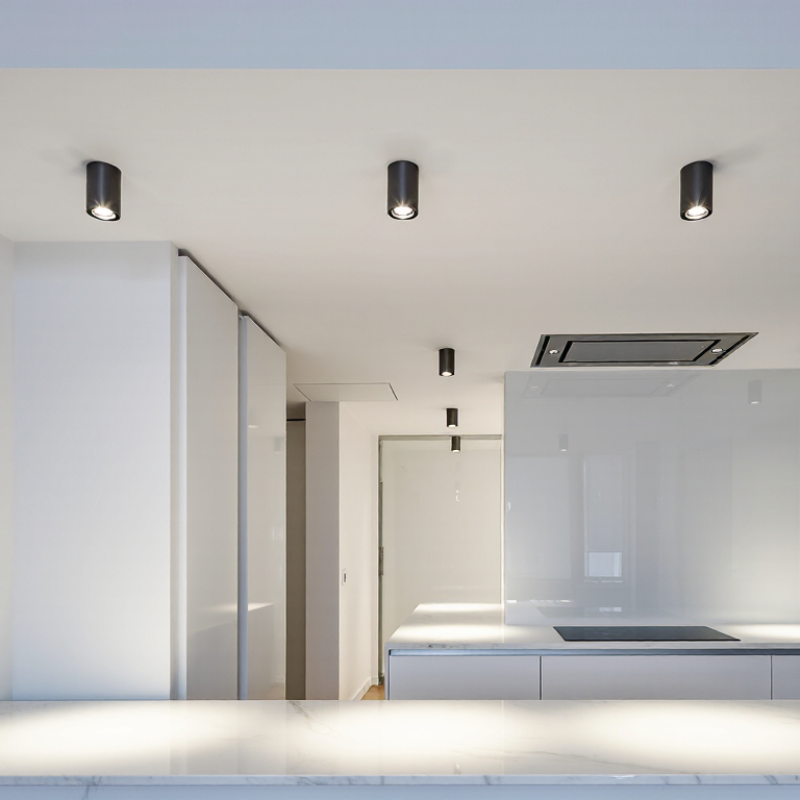
What Trimless Spotlights Are and How They Integrate with Ceilings
A trimless spotlight is a recessed fixture designed to sit flush with a plastered ceiling. Its mounting flange is covered with joint compound and paint, leaving a neat aperture around the light. The ceiling becomes part of the fixture’s finish. The detail is unforgiving. Poor alignment or rushed plastering can leave visible ridges, hairline cracks, or uneven shadows.
Integration starts before the ceiling is closed. Installers need to check housing depth, joist positions, insulation, and access to the driver. Leave enough room for servicing. For a useful energy reference, the U.S. Department of Energy’s Energy Saver guidance says LEDs use at least 75% less energy than incandescent lighting and may last up to 25 times longer. These figures describe LED lighting broadly, not trimless fittings specifically. UNEP and GlobalABC’s 2022 Global Status Report for Buildings and Construction attributed 34% of global energy demand and 37% of energy- and process-related carbon dioxide emissions to buildings and construction.
When comparing trimless spotlights made in China, check the cut-out dimensions, ceiling thickness range, driver location, and dimming compatibility. Ask for installation drawings and photometric data, then confirm them against the actual ceiling build-up. A small sample installation can reveal problems that a specification sheet misses. Seamless results are possible, but they depend as much on careful site work as on the fitting itself.
| Spotlight Type | Typical Light Output and Beam | Best-Suited Applications | Ceiling Integration | Key Checks When Sourcing |
|---|---|---|---|---|
| Fixed trimless downlight | Approximately 5–15 W; commonly available with beam angles around 24°–60° | General lighting in living rooms, bedrooms, corridors, and other areas where a fixed direction is suitable | A plaster-in frame or housing is fitted into the ceiling and finished with plaster, leaving the light aperture visually integrated with the surface. | Confirm ceiling cut-out, installation depth, driver location, glare control, and whether the frame is compatible with the specified ceiling construction. |
| Adjustable trimless spotlight | Approximately 7–20 W; often offered with narrower beams, such as 15°–36° | Accent lighting for artwork, shelving, architectural details, or selected areas of a room | The recessed fitting sits flush with the finished ceiling while the inner spotlight module tilts or swivels below the ceiling plane. | Check the stated tilt and rotation, aiming clearance, beam angle, and whether adjustment changes the visible glare or light distribution. |
| Deep-recessed or low-glare trimless spotlight | Approximately 5–15 W; commonly paired with medium or narrow beams | Comfort-focused residential, hospitality, and office spaces where the light source should be less visible from normal viewing angles | The lamp or LED module is set farther back in the fitting; the trimless frame is plastered into the ceiling in the same way as other recessed types. | Compare shielding depth, beam performance, output, and photometric data. “Low glare” is not a substitute for a published UGR value where one is required. |
| Trimless wall-washer spotlight | Approximately 7–20 W; designed to spread light broadly across a vertical surface | Highlighting walls, curtains, display areas, and textured finishes | The fitting is recessed flush into the ceiling and must be positioned at a suitable distance from the wall to produce an even wash. | Request the manufacturer’s spacing guidance or photometric files; wall distance and fitting spacing affect uniformity and scalloping. |
| Miniature trimless spotlight | Approximately 1–6 W; output and beam options vary by aperture and LED design | Small-scale accents, joinery, display niches, and installations where a discreet aperture is preferred | A compact plaster-in frame is finished into the ceiling. The required driver may need to be installed separately where accessible. | Verify the actual aperture and housing dimensions, minimum installation depth, heat management, and driver access before ordering. |
| Typical specification options across product types | Common options include 2700 K, 3000 K, 3500 K, and 4000 K; CRI 80+ is widely available, with CRI 90+ options. Dimming depends on the driver. | Choose color temperature, color rendering, output, and dimming to suit the room and project requirements. | Driver and wiring arrangements should be coordinated with the ceiling plan and made accessible for maintenance where required. | Request the exact model’s data sheet, lumen output, wattage, beam angle, CRI, driver compatibility, certificates, and warranty terms. Specifications vary by model and supplier. |