
Choosing the right Galvalume Corrugated Sheet requires more than comparing prices or surface appearance. The correct choice depends on roof design, weather exposure, structural demands, and installation conditions. A sheet that performs well on a dry warehouse may fail earlier in a coastal or industrial environment. Small details matter.
Start with the coating specification. Galvalume commonly combines aluminum, zinc, and silicon to improve corrosion resistance and heat performance. Check the coating mass, steel thickness, yield strength, and profile dimensions. Confirm whether the product meets recognized standards, such as ASTM or EN requirements. Supplier test reports should support these claims. Do not rely only on a polished sample.
Think about the building’s location. Salt air, heavy rainfall, snow loads, and chemical fumes can change the material decision. Roof pitch also affects drainage and long-term staining. Select compatible fasteners, flashings, sealants, and insulation. Mixed metals may create unexpected corrosion. This is often overlooked.
Installation quality matters just as much. Poor cutting, exposed edges, or overtightened screws can damage the protective coating. A qualified installer should follow the manufacturer’s guidance and inspect overlaps carefully. Experience shows that many roof problems begin during installation, not manufacturing. Still, every project has limitations. No single Galvalume Corrugated Sheet fits every application. That assumption deserves a second look.
A reliable supplier should provide clear specifications, warranty terms, maintenance advice, and traceable quality records. Compare the complete system, not just the sheet price. The cheapest option may create higher replacement costs later. Careful selection supports safer construction, longer service life, and more predictable performance.
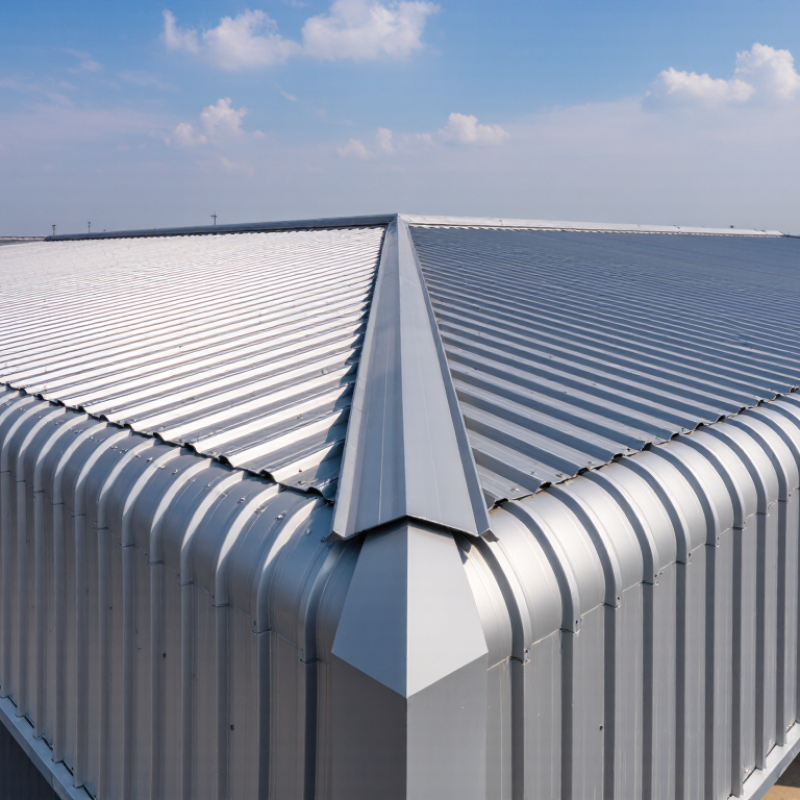
A galvalume corrugated sheet is a shaped steel panel protected by an aluminum-zinc alloy coating. The coating usually contains about 55% aluminum, with zinc and silicon added for balance. Exact proportions can vary by production standard. The steel core provides strength, while the metallic coating helps resist moisture, heat, and surface corrosion.
Its corrugated profile is more than a visual detail. Ridges increase stiffness and help water run toward the lower edge. During a site inspection, check whether the valleys are clean and evenly formed. Small dents can collect water. That creates trouble later. Look also for exposed edges, coating scratches, and uneven color. A bright surface does not always mean better performance.
When choosing a galvalume corrugated sheet, compare coating mass, steel thickness, profile depth, and the local climate. Coastal air, industrial pollution, and frequent condensation can shorten service life. Ask for test documents showing tensile strength, coating weight, dimensions, and thickness tolerance. Do not rely only on nominal thickness, because actual measurements may differ slightly. Fastener compatibility matters too; unsuitable screws can damage the coating around each hole. A careful installer should avoid dragging sheets across one another. It seems minor, but repeated friction leaves marks that are easy to miss.
How to Choose Galvalume Corrugated Sheet?
Which Galvalume Sheet Specifications Match Your Project?
Start with the roof’s actual demands, not a familiar gauge. ASTM A792/A792M commonly lists AZ50 and AZ55 coating designations, measured by total coating mass on both surfaces. The alloy contains approximately 55% aluminum, 43.4% zinc, and 1.6% silicon. For ordinary agricultural or residential roofs, AZ50 may be adequate when drainage is reliable. Coastal air, industrial fumes, or frequent condensation may justify AZ55, protective paint, or another material. These choices require site judgment.
Thickness should follow span, wind pressure, snow load, and purlin spacing. A 0.45 mm sheet may work for short spans, but a 0.60 mm sheet gives greater stiffness and screw pull-out resistance. Do not compare “24 gauge” across suppliers without checking millimeters; gauge conventions can vary. Select the corrugation profile next. Deeper ribs improve load capacity, while wider sheets reduce lap joints. The wrong profile can waste steel and still vibrate under rain.
Surface performance matters indoors, too. The U.S. Department of Energy identifies solar reflectance and thermal emittance as key cool-roof variables, not color alone. Ventilation beneath the sheet also controls heat and condensation. Use fasteners compatible with the coating, and specify washer type, lap direction, and cut-edge treatment. I have seen projects over-specify coating mass while ignoring under-roof airflow. That is an expensive lesson. Require test certificates, thickness records, and coating results before installation, then inspect scratches and exposed edges on site.
Which Galvalume sheet specifications match your project? Compare common ASTM A792 AZ coating designations by their approximate total coating mass on both sides.
AZ50 and AZ55 are widely used for general roofing and siding applications. AZ150 provides a substantially heavier aluminum-zinc coating and may be considered for more demanding exposure conditions, subject to the project standard and environment. Choose sheet thickness according to span, wind load, structural support, and forming requirements; coating mass alone does not determine panel strength. ASTM A792 coating designations are based on total coating mass on both sides, and the final specification should be verified with local building codes and engineering requirements.
Choosing a galvalume corrugated sheet starts with its coating, not its appearance. The usual alloy contains about 55% aluminum, 43.4% zinc, and 1.6% silicon by weight. Aluminum supports corrosion resistance, while zinc helps protect exposed edges. ASTM A792/A792M-23 identifies coating classes such as AZ50 and AZ55. These represent 0.50 and 0.55 ounces per square foot across both surfaces, respectively. That equals roughly 152 and 168 g/m². Check the certificate, not only the supplier’s label. Coating mass is not the same as base-metal thickness.
Thickness must match the span, wind exposure, fixing pattern, and maintenance access. A thinner sheet may reduce cost, but it can show oil canning and dent more easily. A thicker sheet adds stiffness, though it may complicate cutting and lifting. The 2023 Metal Construction Association design guidance treats panel geometry as part of structural performance. Profile depth, pitch, and rib shape affect drainage and load distribution. A deep profile can improve spanning, but it is not automatically better. Local codes and engineering calculations still control the choice.
Tips: Ask for base-steel thickness, coating designation, yield strength, and test results. Compare effective cover width, not nominal width. Inspect cut edges and the underside for uneven coating. Avoid mixing profiles from different systems. My practical mistake was judging sheets by gauge alone; profile geometry changed the result more than expected. Allow room for that uncertainty.
| Evaluation Dimension | Typical Option or Range | Key Technical Information | Recommended Use | What to Verify Before Purchase |
|---|---|---|---|---|
| Base Material | Cold-formed steel sheet with an aluminum-zinc coating | Galvalume coating is primarily aluminum and zinc, commonly with a small silicon addition. The aluminum-rich surface provides barrier protection, while zinc helps provide sacrificial protection at cut edges. | Roofing, wall cladding, agricultural buildings, workshops, and light industrial structures | Steel grade, yield strength, coating standard, and whether the sheet is intended for structural or non-structural use |
| Coating Designation | AZ50 or AZ55 | Under ASTM A792/A792M, AZ50 indicates a minimum total coating mass of approximately 150 g/m² on both sides, while AZ55 indicates approximately 165 g/m² on both sides. | AZ50 for many standard applications; AZ55 where a higher coating mass is preferred | Confirm that the designation refers to total coating mass on both sides, not the coating mass on one side only |
| Coating Thickness | Approximately 20–30 micrometres per side for common commercial coating levels | Actual thickness varies according to coating mass, density, process control, and measurement location. Coating mass is normally a more reliable specification than visual appearance. | Use the higher coating level for more demanding exposure, subject to the project specification | Mill test certificate, coating-mass test method, minimum values, and tolerance requirements |
| Steel Thickness | 0.40–0.50 mm: light-duty; 0.60–0.80 mm: higher rigidity | Increasing base-metal thickness generally improves stiffness, fastener pull-out resistance, dent resistance, and allowable span, but it also increases weight and cost. | Choose thickness from structural calculations rather than appearance alone | Nominal thickness versus base-metal thickness, thickness tolerance, design load, support spacing, and local building code |
| Profile Depth | Approximately 18–35 mm for common corrugated profiles | A deeper corrugation usually increases section stiffness and may permit greater support spacing, provided the sheet thickness and profile geometry are suitable. | Shallower profiles for short spans; deeper profiles for larger spans or higher imposed loads | Profile depth, pitch, crest width, valley width, effective cover width, and published load tables |
| Profile Pitch | Approximately 60–200 mm, depending on the profile design | Pitch affects the number of ribs per sheet, visual appearance, drainage behavior, side-lap arrangement, and effective cover width. | Select a pitch that matches the roof layout, appearance requirements, and compatible accessories | Net cover width after side laps, minimum roof slope, side-lap location, and availability of matching flashings |
| Roof Slope | Often specified at approximately 5° or greater, subject to profile and joint design | The minimum slope depends on profile geometry, sheet length, end laps, weather sealing, rainfall, snow, and wind conditions. A steeper slope generally improves drainage. | Use the profile manufacturer's tested minimum slope and the applicable building code | Minimum slope, end-lap requirements, sealant specification, and local climate exposure |
| Surface Finish | Regular spangle, minimized spangle, or smooth/skin-passed finish | Finish affects visual uniformity and may influence the appearance of paint or protective treatments. It does not replace the need to specify the correct coating mass. | Choose according to appearance, painting requirements, and project specifications | Surface uniformity, oil or passivation treatment, paint compatibility, and allowable cosmetic variation |
| Cut Edges and Fastener Areas | Factory-cut edges with compatible corrosion-resistant fasteners | Galvalume performs well in many atmospheric environments, but exposed cut edges, scratches, trapped moisture, and incompatible metals can accelerate corrosion. | Use correct fasteners, washers, laps, sealants, and edge-protection procedures | Fastener material, washer type, galvanic compatibility, edge treatment, and storage conditions |
| Exposure Conditions | Rural, urban, industrial, coastal, or high-humidity environments | Salt spray, persistent condensation, industrial pollutants, animal waste, and contact with wet concrete or treated timber can reduce service life. | Use a suitable coating, detailing system, and maintenance plan for the actual environment | Site exposure classification, drainage, ventilation, condensation risk, and chemical contaminants |
| Structural Verification | Manufacturer load tables or engineer-designed calculations | Capacity depends on thickness, yield strength, profile geometry, support spacing, fastener layout, wind uplift, snow load, and deflection limits. | Use engineering calculations for occupied, high-wind, snow-load, or long-span structures | Design loads, span tables, allowable deflection, screw pattern, and compliance with local standards |
| Quality Documentation | Inspection certificate and dimensional inspection report | A complete record should identify steel grade, base-metal thickness, coating designation, mechanical properties, dimensions, and test results. | Essential for commercial, industrial, and code-regulated projects | Traceability, batch identification, dimensional tolerances, coating test results, and conformity statement |
Choosing a galvalume corrugated sheet starts with local conditions, not appearance. Galvalume combines aluminum, zinc, and steel for balanced corrosion resistance. However, performance changes with climate, installation quality, and building use.
In humid coastal areas, salt carried by wind can accelerate corrosion at cut edges and fasteners. Choose a suitable coating thickness and use compatible screws with reliable sealing washers. For heavy rainfall, a steeper roof slope and deeper corrugations can improve water drainage. In hot regions, lighter-colored surfaces may reduce heat absorption, although insulation remains important. Snow, strong winds, and large temperature changes also affect the required sheet thickness and support spacing. Local building requirements should guide the final selection.
Tips: Check a physical sample. Inspect the coating, edges, and profile. Ask for test data and installation guidance. Do not judge quality by shine alone. I once underestimated the effect of salt air; the roof looked sound, but exposed cut edges showed early staining. That experience changed my approach. Consider maintenance access, roof pitch, and nearby industrial pollution before ordering. A thinner sheet may cost less initially, yet it can feel less secure under wind or foot traffic. The cheapest option is not always the most practical.
Comparing galvalume corrugated sheets starts with identical specifications. Check the base steel thickness, coating mass, profile depth, and effective cover width. A sheet may look bright and even, yet its core can be thinner than stated. Ask for mill certificates, coating test results, and dimensional tolerances. Inspect the edges for rough cuts, exposed steel, or uneven coating. These small details often appear after installation.
Cost needs a wider view than the price per square meter. Include freight, fasteners, cutting waste, unloading, and expected maintenance. I once compared two quotations that seemed far apart. The cheaper option used a thinner substrate and created more overlap waste. It was not truly cheaper. Request samples from the same production lot when possible. Measure thickness with a calibrated gauge, not by hand. Still, gauges can be misused. Record several readings.
Supplier reliability is visible in practical behavior. Does the supplier answer technical questions clearly? Can they confirm production dates, packing methods, inspection procedures, and replacement terms? Ask for recent project references, but verify them independently. A polished certificate is not enough. Communication during a delay matters more than impressive promises. Trial orders can reveal packing quality, color consistency, and document accuracy. I would also compare claims against delivered sheets, because assumptions sometimes survive longer than evidence.
