
What Are the Top 10 Forklift Pallet Manufacturers in China?
Forklift Pallets look simple until a loaded pallet turns, stops, or meets a damaged warehouse floor. Then deck thickness, entry design, load rating, and material choice matter. China’s supplier base is broad, but product claims need careful checking.
The China Federation of Logistics and Purchasing reported that China’s total social logistics value reached RMB 352.4 trillion in 2023, up 5.2% year over year. This measures logistics activity, not pallet sales. Still, it shows the scale of movement that storage and handling products must support. The World Bank’s 2023 Logistics Performance Index offers broader context on logistics capability, but it does not rank pallet makers. Buyers should therefore assess manufacturers through verifiable specifications, factory audits, sample testing, and references—not market size alone.
A useful expert lens comes from MIT supply-chain scholar Yossi Sheffi, whose published work examines resilience and supply-chain risk. For this guide, the takeaway is: “A pallet is a small component with a large operational role.” This is an editorial summary, not a verbatim quotation. That distinction matters.
The following list compares ten Chinese manufacturers by product range, materials, customization, export experience, and evidence of quality control. Look closely at the details. A low quoted price may exclude testing, tooling, or freight. And a polished catalog is not proof of performance. The comparison is a starting point, not a substitute for checking the pallet against your actual forklift, rack, and load conditions.
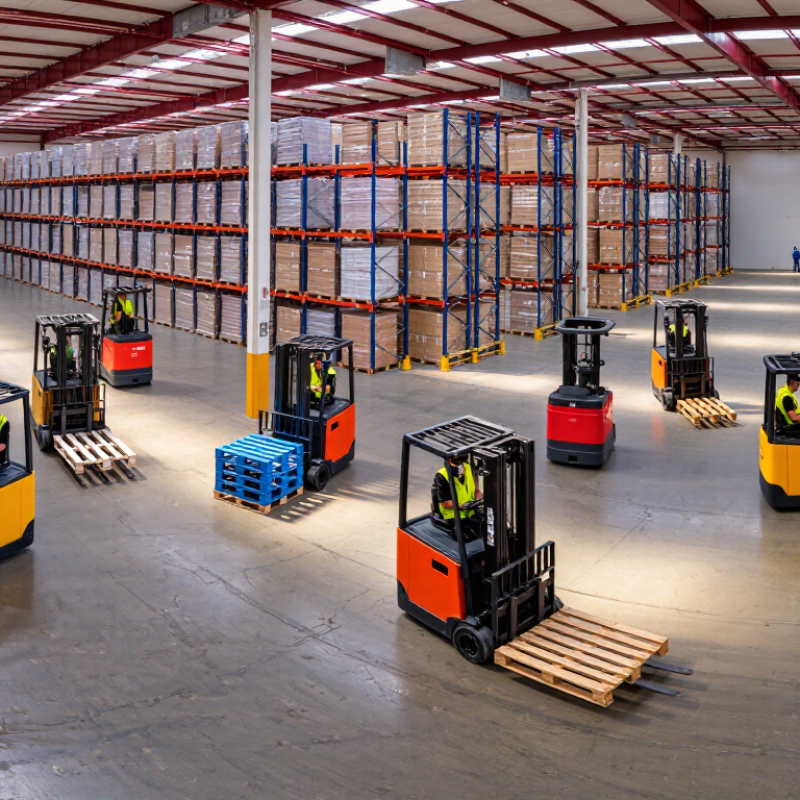
Understanding Forklift Pallets and Their Main Types
Forklift pallets are load platforms designed to work with fork tines, but their construction affects stability, handling, and service life. Wooden pallets are common because they are easy to repair and suit many general warehouse loads. They may absorb moisture, though, and loose boards or protruding nails can create problems during repeated handling. Inspect them closely.
Plastic pallets resist moisture and are often easier to clean. Their molded surfaces can also provide consistent dimensions for automated storage systems. However, a plastic pallet that flexes under a heavy load may be unsuitable, even if it looks intact. Check its rated capacity and confirm that the rating applies to the way the load will be supported.
Metal pallets, usually made from steel or aluminum, are built for demanding environments and repeated use. They can be heavy, so operators should account for pallet weight when checking the total load. Nestable designs save floor space when empty; stackable designs support stable storage when loaded. A two-way-entry pallet accepts forks from two sides, while a four-way-entry design allows access from all four. Not every forklift or rack suits every pallet. Measure fork openings, pallet dimensions, and rack clearances before choosing a type. Real warehouse conditions can be messier than a specification sheet suggests. A small trial with typical loads can reveal handling issues before a large order.
| No. | Pallet Type | Typical Material | Common Nominal Size (L × W) | Forklift Entry | Typical Characteristics | Common Applications |
|---|---|---|---|---|---|---|
| 1 | Stringer wood pallet | Solid wood boards and stringers | 1200 × 1000 mm | Usually two-way; four-way entry is possible with notched stringers | Repairable and widely available; design and load rating vary with timber, fasteners, and construction. | General warehousing, manufacturing, and domestic freight |
| 2 | Block wood pallet | Solid wood boards and blocks | 1200 × 1000 mm or 1100 × 1100 mm | Often four-way entry | Block-supported construction can provide access from multiple sides; suitability for racking depends on the specific design. | Distribution centers and multi-directional material handling |
| 3 | Nestable plastic pallet | High-density polyethylene (HDPE) or polypropylene (PP) | 1200 × 1000 mm or 1100 × 1100 mm | Generally two-way or four-way, depending on design | Empty pallets can nest to save storage and return-transport space; confirm load ratings before use. | Closed-loop distribution and space-conscious storage |
| 4 | Rackable plastic pallet | HDPE or PP, sometimes with reinforcing inserts | 1200 × 1000 mm or 1200 × 800 mm | Usually four-way entry | Designed for specified support conditions; rack use requires checking the manufacturer’s rated load and rack configuration. | Warehouses using pallet racking and automated handling |
| 5 | Hygienic plastic pallet | Washable HDPE or PP | 1200 × 1000 mm or 1200 × 800 mm | Typically two-way or four-way | Smooth surfaces can be easier to wash than many wood designs; hygiene suitability depends on construction and cleaning procedures. | Food, pharmaceutical, and other controlled-cleanliness operations |
| 6 | Steel pallet | Welded or formed steel | 1200 × 1000 mm or 1100 × 1100 mm | Two-way or four-way, depending on frame design | Durable and suitable for demanding environments, but generally heavier than wood or plastic alternatives. | Heavy industrial goods, metal products, and reusable transport systems |
| 7 | Aluminum pallet | Aluminum sections or sheet construction | 1200 × 1000 mm or application-specific sizes | Varies by design | Corrosion-resistant and relatively light for a metal pallet; purchase cost and repair options depend on construction. | Specialized logistics and environments requiring corrosion resistance |
| 8 | Corrugated paper pallet | Corrugated fiberboard | 1200 × 1000 mm or shipment-specific sizes | Designed for compatible forklift or pallet-jack access | Lightweight and often intended for one-way shipments; moisture exposure and load support must be assessed. | Export shipments and lightweight, dry cargo |
| 9 | Pressed-wood pallet | Molded or compressed wood fiber | Commonly around 1200 × 1000 mm; other sizes are available | Entry openings depend on the molded design | Often nestable and made as a single molded unit; capacity and handling features vary by model. | Export packaging and space-efficient empty-pallet storage |
| 10 | Composite pallet | Mixed materials, such as plastic with reinforcing elements | 1200 × 1000 mm or application-specific sizes | Varies by design | Combines material features to meet a particular handling requirement; inspect the stated load rating and repair policy. | Reusable supply chains with defined durability or handling requirements |
| Scope note: This table compares common forklift pallet types and does not rank or identify individual manufacturers. Dimensions are representative nominal formats, not guarantees of availability. Dynamic, static, and racking load capacities depend on pallet design, condition, load distribution, and support conditions; verify the rated capacity and forklift compatibility for each specific model. | ||||||