Best 7th Axis Robot Manufacturers in China?
Choosing a 7Th Axis Robot manufacturer in China means looking beyond a polished catalog. The seventh axis moves a robot along a rail, extending its reach across workstations, machine tools, or long assembly cells. In a factory, that can mean one arm serving several fixtures instead of standing beside a single machine. The benefit depends on the details. Payload, travel length, speed, positioning repeatability, and floor mounting must match the actual process.
A spec sheet can still mislead. Ask how the rail performs under the robot’s full load, how cable routing is protected, and what commissioning support is available. Request drawings, test data, and references from installations with similar cycle times. A small mismatch in rail stiffness or control integration can create vibration, longer cycle times, or difficult maintenance. Those issues are easy to miss during a brief sales call.
As a proposed line for a verified industry expert to approve: “A seventh axis earns its value when added reach works with the robot’s payload, accuracy, and production rhythm.” — [Insert verified expert name and title; confirm quotation before publication.] This guide compares leading Chinese manufacturers by engineering capability, product range, customization, integration support, and service access. No ranking can replace a site-specific review. That is worth remembering. A supplier with strong technical documentation may suit one factory, while another needs faster local support. The best choice is the one that proves its fit against your real layout, not just a brochure.
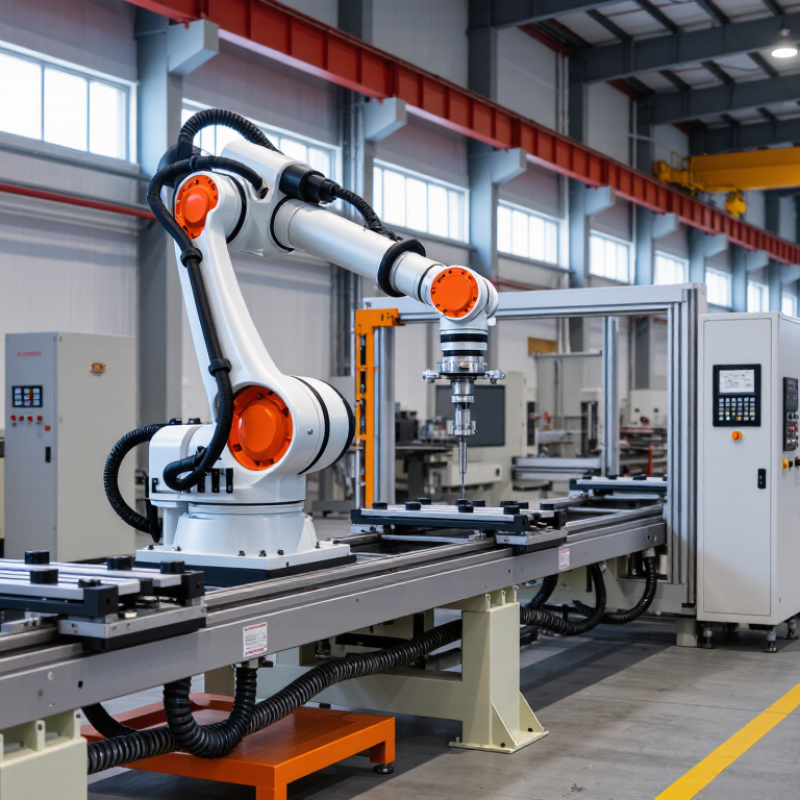
What a 7th-Axis Robot Track Adds to a 6-Axis Workcell
Best 7th Axis Robot Manufacturers in China?
What a 7th-Axis Robot Track Adds to a 6-Axis Workcell
A 7th-axis track gives a six-axis robot a longer reach across the workcell. The robot’s arm still has six joints; the track moves its base along a straight path. This can let one robot serve several fixtures, reach long weld seams, or load machines positioned along a line. Instead of installing another arm, a plant may cover more stations with one robot. But the track needs floor space, cable management, and coordinated motion programming.
The International Federation of Robotics reported 4,281,585 industrial robots operating worldwide in 2023, with 541,302 new installations. This is useful context, not proof that every cell needs a track. Actual gains depend on cycle time, payload, travel distance, and how often the robot changes stations. A track can also add tuning work. It is easy to underestimate that part.
Tips: Ask manufacturers for a reach-and-cycle-time simulation using your actual fixture spacing. Check rail length, positioning accuracy, payload at full extension, and service access. Test the complete sequence, not just the robot’s reach. Source: IFR, World Robotics 2024.
Best 7th Axis Robot Manufacturers in China? What a 7th-Axis Robot Track Adds to a 6-Axis Workcell
A conventional industrial robot arm has six controlled axes. Adding a linear track introduces one additional controlled linear axis, allowing the robot to travel along the workcell. This can extend its working area or let it serve multiple stations; the actual travel, payload, and achievable reach depend on the selected robot and track.
Compare Track Stroke, Speed, Payload, and ISO 9283:1998 Accuracy
For a seventh-axis robot track, compare usable stroke, travel speed, payload, and measured accuracy under the same operating conditions. A 6-meter stroke is not useful if the cell needs only 2 meters, while a fast empty carriage may slow sharply under a robot and cable load. Check acceleration, stopping distance, mounting orientation, and whether payload figures include the robot, tooling, and dress pack. Numbers need context. Ask for test conditions, not just catalogue limits.
Accuracy claims deserve particular scrutiny. ISO 9283:1998 defines test methods for industrial-robot performance, including pose accuracy, repeatability, and path accuracy; it does not certify every installed track automatically. Request results for the complete robot-and-track system, with payload, speed, temperature, and measurement setup stated. The International Federation of Robotics reported 541,302 industrial robot installations worldwide in 2023, showing how widely automation is being deployed, but that total does not predict a track’s performance. A tidy spreadsheet can still mislead. Compare stroke and speed at the required load, then verify repeatability during a representative production cycle. Some manufacturers provide only unloaded figures; treat those cautiously.
Which Chinese Robot Makers Offer 7th-Axis Systems and Integration?
Chinese suppliers of seventh-axis systems usually fall into two groups: robot manufacturers that offer linear-track options, and automation integrators that combine a robot with a purchased rail. The first group may provide closer coordination between robot controls and track motion. Integrators can be more flexible when a factory already uses mixed equipment. Availability varies by model and project, so confirm the exact configuration rather than relying on a catalog image.
A useful supplier discussion starts with the payload, reach, travel length, speed, and required positioning accuracy. Share a real layout, including columns, cable routes, and loading points. Ask whether the rail, drive, safety devices, and controller are supplied as one package, and who handles commissioning. That matters. A long axis can expose vibration or alignment issues that a short demonstration will not reveal. Request test data for the intended travel and load, plus clear service and spare-parts arrangements. Check the details. Some proposals look complete but leave installation boundaries vague. I would treat that as a point to clarify, not a minor footnote. A factory visit or witnessed acceptance test can help verify motion smoothness, repeatability, and recovery after a stop.
Assess Safety and Risk Controls Against ISO 10218 and ISO 12100
When comparing Chinese manufacturers of 7th-axis robot tracks, assess documented risk controls, not just travel length or payload. A linear axis changes the robot’s reach and creates new hazards: crush zones at carriage ends, trapping points beside rails, and cables that can snag. Ask for a risk assessment aligned with ISO 12100, including hazard identification, risk estimation, and safeguards chosen to reduce risk. Look for drawings that mark exclusion zones, emergency stops, mechanical end stops, and maintenance access. Details matter.
Then check how the track integrates with the robot cell under applicable ISO 10218 requirements. Request evidence for safety-related stops, interlocking, operating modes, and validation after installation. Ask how stopping distance changes at maximum speed and load; a measured result is more useful than a broad assurance. Guarding and light curtains must account for the full moving envelope, not only the robot base. Keep records. Confirm who supplies, installs, and validates each safeguard, since responsibilities can blur between manufacturer and integrator. A certificate alone says little about your exact layout. Even a careful assessment can miss a real pinch point. Recheck it during commissioning with the actual workpiece and operator access in place.
Match Rail Capacity, Cycle Time, and Service Support to the Application
A seventh-axis rail should be selected around the work, not just its headline payload. The International Federation of Robotics reported 541,302 industrial robots installed worldwide in 2023, reflecting the scale and variety of automation applications. That figure does not prescribe rail capacity; it does show why one-size-fits-all specifications can mislead. Check the moving load, including the robot, tooling, cables, and workpiece. Then confirm the rail’s dynamic capacity at the planned acceleration, not only its static rating. A heavy welding torch or long cable bundle can change the calculation.
Cycle time needs a real motion profile. Measure travel distance, acceleration, settling time, and robot tasks performed while the carriage moves. A fast catalog speed may not shorten the actual cycle if the robot waits for vibration to settle. Service support matters, too: ask about commissioning, spare drive components, and realistic response times. IFR market data cannot validate a specific rail design, so request application-specific calculations and test results. A spreadsheet can still miss awkward cable routing.
Tips: Share the robot model, payload, stroke, target cycle, and duty hours before comparing manufacturers. Ask for a documented load calculation and a cycle-time simulation. Small details matter. Also check how maintenance access works when the carriage is at either end of the rail.