2026 Top HVLS Motors for Global Buyers?
Choosing the right Hvls Motors in 2026 requires more than comparing horsepower and purchase prices. Global buyers must examine airflow performance, energy use, duty rating, noise, installation conditions, and long-term service support. A motor that performs well in a warehouse may not suit a livestock building, airport terminal, or humid production plant.
This guide focuses on practical buying decisions from an engineering and operating perspective. It considers permanent-magnet motors, direct-drive systems, variable-frequency control, thermal protection, and compatibility with large industrial fans. Real-world details matter. A dusty warehouse can challenge cooling paths, while voltage fluctuations may affect controller stability. Buyers should also verify efficiency data, testing methods, warranty terms, spare-parts access, and regional technical support before approving a supplier.
Certifications deserve careful review. Requirements differ between markets, and a familiar logo does not always prove complete product suitability. Ask for traceable test reports, installation guidance, and clear maintenance procedures. A reliable supplier should explain expected service life without hiding operating assumptions.
No shortlist is perfect. Published efficiency may change under different loads, temperatures, or fan diameters. That limitation deserves attention. This overview will compare leading 2026 HVLS Motors through performance, durability, control quality, safety documentation, and total ownership cost. It aims to help distributors, contractors, and facility managers make decisions based on evidence rather than attractive specifications alone. In practice, the quietest motor is not always the most valuable choice. Stable airflow, dependable support, and predictable maintenance may matter more over ten years.
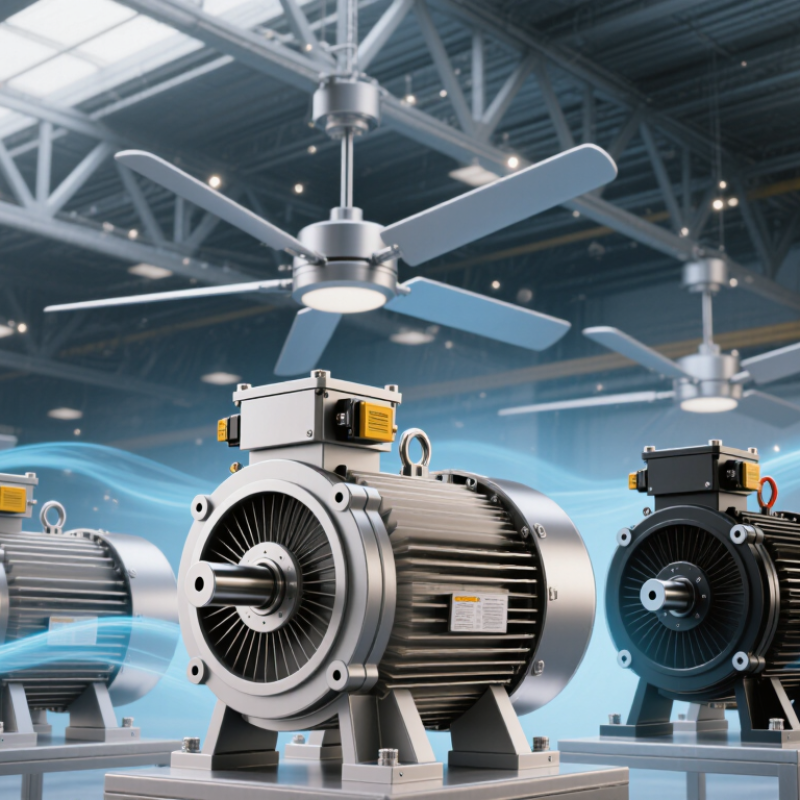
HVLS Motor Basics: 0.75–2.2 kW Ratings, 50/60 Hz, and IP55 Protection
2026 Top HVLS Motors for Global Buyers?
HVLS motors commonly use power ratings from 0.75 to 2.2 kW. This range supports large ceiling fans in warehouses, workshops, and public halls. Lower ratings suit lighter blades and moderate ceiling heights. Higher ratings provide stronger torque for wider blade spans. Motor selection should follow fan diameter, load, duty cycle, and local voltage. Bigger is not always better. Oversizing can increase energy use and starting stress.
Frequency also matters. A 50 Hz motor may require different speed control than a 60 Hz model. Some global projects need dual-frequency compatibility. Buyers should verify rated voltage, current, insulation class, and controller matching. A motor can run, yet perform poorly under the wrong frequency. That detail is often missed.
IP55 protection helps shield the motor from dust and low-pressure water jets. It does not mean waterproof operation or safe outdoor exposure without added protection. In practical inspections, sealed cable entries and correct grounding matter as much as the rating. Check the enclosure after installation. Small gaps can weaken real protection. Ask for routine test records, temperature-rise data, efficiency values, and noise measurements. These documents improve supplier comparison, although they cannot replace a hands-on inspection. Some published performance figures may reflect ideal laboratory conditions. Real warehouses are less forgiving.
Airflow Metrics: Evaluating HVLS Motors Above 100,000 m³/h
For 2026 global buyers, HVLS motor selection should begin with verified airflow, not motor horsepower. Above 100,000 m³/h means 27.8 m³/s, yet that figure needs a defined test condition. AMCA 210 specifies laboratory methods for fan aerodynamic performance, including airflow, pressure, and power measurements. Ask for the complete test point. A catalog maximum is not a warehouse result.
In its 2022 Industrial Motor System Market Assessment, the U.S. Department of Energy reports that motor-driven systems use about 54% of U.S. manufacturing electricity. That makes efficiency relevant, but airflow per watt matters more than a larger nameplate. Compare delivered m³/h per kilowatt at the same static pressure. Measure it. The ASHRAE Handbook—HVAC Applications 2023 links air distribution performance to space geometry, heat loads, and occupied-zone conditions. Therefore, 100,000 m³/h across 1,000 m² averages 100 m³/h per square metre, before losses.
During procurement trials, I would record voltage, speed, power, sound, and temperature. Use a calibrated anemometer grid, not one center reading. Small errors multiply. Ceiling height, obstructions, and door operation can sharply reduce useful circulation. I have seen strong airflow fail near racking and loading bays. Buyers should request AMCA-aligned test evidence, duty-point curves, and a stated air-density basis. Some specifications remain incomplete.
Global Buyer Standards: IEC, CE, UL, and 400 V Three-Phase Compatibility
2026 Top HVLS Motors for Global Buyers?
Global Buyer Standards: IEC, CE, UL, and 400 V Three-Phase Compatibility
HVLS motor selection now depends on compliance, not only airflow. The IEA’s Energy Efficiency 2023 report states that electric motor systems consume about half of global electricity. Small efficiency losses can therefore become significant operating costs. Buyers should request IEC 60034 test results, rated efficiency, insulation class, and service-factor data. IEC 60034-30-1 efficiency classes also help compare motors fairly across suppliers.
CE marking requires a valid declaration covering applicable European safety and electromagnetic requirements. It is not simply a quality certificate. For North American projects, UL evaluation should cover the motor, controller, wiring, and protection system. UL 1004-1 is relevant for motor safety, but the complete HVLS assembly still needs review. A 400 V three-phase motor may fit many industrial sites, yet frequency, phase sequence, voltage tolerance, starting current, and drive compatibility can differ. A certificate alone does not guarantee quiet operation. This is where buyers should stay skeptical.
Tips: Ask for the nameplate photo, wiring diagram, efficiency report, and EMC test evidence. Confirm 400 V at 50 Hz or 60 Hz before ordering. Check whether the controller supports local protection settings. In commissioning practice, overlooked frequency details still cause avoidable failures. The paperwork may look complete, but one missing test can change the risk.
2026 Top HVLS Motors for Global Buyers: IEC, CE, UL and 400 V Three-Phase Compatibility
The chart compares representative three-phase line-to-line supply voltages used in industrial markets. A 400 V, 50 Hz supply is the IEC reference commonly specified for many global applications, while 415 V is widely encountered in parts of Asia, Africa and Oceania. The 440–480 V range is common in North American industrial systems. Buyers should confirm the motor nameplate voltage, frequency, phase configuration and permissible tolerances before installation.
IEC 60034-1 addresses rotating electrical machine ratings and performance. CE marking indicates applicable European Union conformity requirements, while UL 1004-1 is a safety standard for rotating electrical machines in the United States and Canada. CE and UL are conformity or safety requirements; they do not by themselves define the motor’s operating voltage.