China has become a major sourcing base for hydraulic cylinder seals, supported by extensive machinery, construction equipment, and industrial manufacturing capacity. Industry reports from MarketsandMarkets and Grand View Research identify continuing demand for hydraulic cylinders as automation, mining, agriculture, and mobile equipment expand. Their findings also indicate that reliability, maintenance costs, and sealing performance increasingly influence purchasing decisions.
Small seal, major consequence.
A leaking rod seal can leave oil around a cylinder head, reduce pressure, and stop a production line. Therefore, this guide evaluates Chinese manufacturers through practical criteria, including material quality, mold precision, compound formulation, dimensional consistency, testing capability, and export experience. Reference points include ISO 5597 for hydraulic pneumatic sealing dimensions, ISO 6020/2 and ISO 6022 for hydraulic cylinder design, plus published technical guidance from Parker Hannifin and Trelleborg Sealing Solutions.
The listed companies are not ranked by factory size alone. Their product range, application knowledge, sample support, quality documentation, and ability to produce polyurethane, PTFE, NBR, FKM, and fabric-reinforced seals also matter. In real purchasing work, a polished website proves very little. Batch records and test results matter more.
Still, no supplier list is perfect.
Actual performance depends on pressure, temperature, rod finish, fluid compatibility, installation accuracy, and working speed. Some manufacturers communicate these limits clearly; others provide incomplete data. That weakness deserves attention. By combining reported market evidence with technical verification, this overview aims to help equipment manufacturers, distributors, and maintenance teams compare China’s leading Hydraulic Cylinder Seals manufacturers with greater confidence.
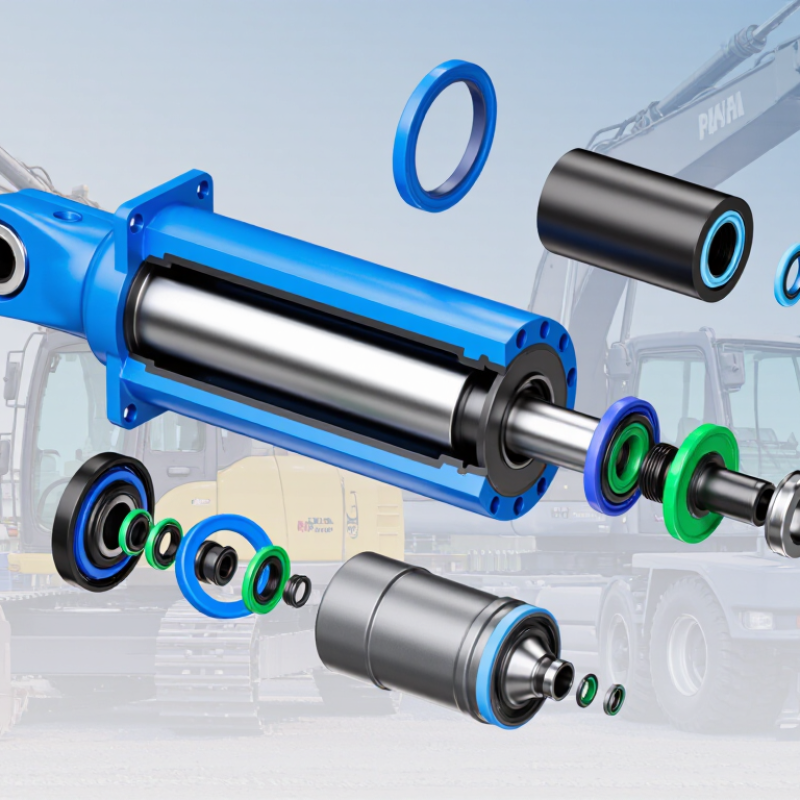
Hydraulic cylinder seals are precision components that keep pressurized fluid inside a cylinder while blocking dust and moisture outside. They include rod seals, piston seals, wipers, and static seals. Each one has a different job. A damaged rod seal may leave a thin oil ring on the shaft. A worn piston seal can cause pressure loss, slow movement, or internal bypassing.
Material selection depends on fluid type, temperature, pressure, and operating speed. Polyurethane handles many demanding applications, while PTFE suits low-friction movement and higher temperatures. Nitrile rubber remains practical for common hydraulic oils. However, no material fits every cylinder. In my experience, poor groove dimensions and rough rod surfaces cause failures as often as incorrect seal materials. That detail is easy to overlook. Reliable manufacturers should provide measured tolerances, material data, and application guidance, not vague claims.
Tips: Check the rod surface before replacement. Look for scratches, rust, or uneven wear. Confirm the seal profile and groove size. Keep seals clean during installation, and use compatible assembly lubricant. A small installation mistake can cut a new seal within minutes. Inspecting the entire cylinder is wiser than replacing one visibly damaged part. Experiences differ, and field conditions may reveal weaknesses that laboratory testing misses.
Evaluating Chinese seal manufacturers requires more than comparing prices. Start with material control, dimensional accuracy, and application experience. Ask how the supplier selects polyurethane, nitrile rubber, or PTFE compounds for pressure, temperature, and fluid exposure. Request batch records, inspection reports, and actual tolerance data. A reliable factory should explain its testing process clearly. Look for pressure cycling, leakage checks, abrasion testing, and low-temperature performance. Photos help, but production-floor evidence matters more. Check molding equipment, clean storage areas, and measurement tools. Small details reveal daily discipline.
Technical drawings should match the finished seal, not just the quotation. Confirm groove dimensions, hardness, surface finish, and installation guidance. Request samples from normal production, rather than specially prepared pieces. A polished sample can mislead.
I have learned this after seeing excellent prototypes followed by inconsistent batches. That weakness deserves attention. Evaluate traceability from raw material to packing label. Ask whether the factory can maintain stable dimensions across repeated orders.
Communication is another practical test. Can engineers discuss failure modes without vague promises? Can they respond with measurements, photographs, and corrective actions? Check delivery records, export documentation, and replacement procedures before signing an agreement.
A manufacturer may have advanced equipment but weak process control. Another may lack impressive marketing while producing dependable seals. Independent inspection and a small pilot order can expose that difference early.
Top Hydraulic Cylinder Seal Manufacturers in China
Top hydraulic cylinder seal manufacturers in China are judged by more than price. They must control material mixing, molding accuracy, and batch traceability. Grand View Research’s 2024 hydraulic seals analysis estimates steady market growth through 2030, driven by construction, agriculture, and industrial machinery. This demand has increased pressure on Chinese manufacturers to improve consistency. A serious supplier should provide compound data, dimensional inspection records, and pressure-test results for every production batch.
The best factories usually produce rod seals, piston seals, wipers, guide rings, and static seals in one quality system. Buyers should inspect sealing lips under magnification. Small molding flash can become leakage after thousands of operating cycles. ISO 3601 dimensions, working temperature, pressure limits, and fluid compatibility also require verification. MarketsandMarkets has reported strong growth in hydraulic equipment demand, but market forecasts differ between research firms. That difference deserves attention.
Ask for samples from actual production tooling, not polished showroom pieces. Request test evidence using the customer’s oil, temperature, and pressure conditions. No factory is perfect. I have seen a seal pass a bench test but fail after side loading and heat exposure. This is why a supplier’s failure analysis matters. Manufacturers with in-house testing, documented corrective actions, and stable export experience offer stronger reliability than traders with attractive catalogs. A lower unit price may hide higher replacement costs.
The chart compares typical continuous operating-temperature ranges of common hydraulic cylinder seal materials used by manufacturers in China and worldwide. Actual performance depends on compound formulation, pressure, fluid compatibility, sealing design, and application conditions.
Top Hydraulic Cylinder Seals Manufacturers in China?
Comparing hydraulic cylinder seal manufacturers requires more than checking unit prices. Start with seal geometry, material hardness, temperature range, pressure rating, and fluid compatibility. A seal that performs well in mineral oil may fail in water-based fluid. Request dimensional drawings, material data, and leakage-test results for the exact product.
Inspect manufacturing capability at the workshop level. Look for controlled molding, stable tooling, automated inspection, and batch traceability. Ask how suppliers measure lip dimensions and surface defects. Reliable manufacturers can explain their sampling plans and provide records, not vague promises. Also compare production capacity, mold development time, minimum order quantities, and realistic lead times. A clean sample may still hide inconsistent batches.
Tips: Ask for three recent inspection reports and one pilot batch. Check whether test conditions match your cylinder’s pressure, speed, temperature, and rod finish. Confirm packaging, storage life, replacement policies, and technical support before ordering. If a supplier avoids basic questions, treat that as useful evidence. Price matters, but an inexpensive seal can increase downtime and labor costs. My own comparison process would include more field data; laboratory results alone can create false confidence.
| Comparison Dimension | Key Technical Data to Review | Relevant Standards or Verification Methods | Practical Evaluation Indicators |
|---|---|---|---|
| Product Scope | Piston seals, rod seals, wiper seals, guide rings, wear rings, static seals, O-rings, and complete seal kits. | Review product drawings, dimensional tables, application data, and compatibility charts. | A capable supplier should support both standard replacement sizes and application-specific profiles. |
| Material Options | Common materials include polyurethane, nitrile rubber, fluorocarbon rubber, PTFE compounds, polyester elastomers, and engineered thermoplastics. | Request compound specifications, hardness data, temperature limits, fluid-compatibility information, and batch traceability. | Material selection should match pressure, speed, temperature, hydraulic fluid, extrusion gap, and surface finish. |
| Dimensional Accuracy | Seal inside diameter, outside diameter, section height, groove dimensions, tolerances, and installation clearance. | Use current technical drawings and applicable ISO dimensional guidance, including ISO 5597 for hydraulic cylinder housing dimensions where relevant. | Check inspection records, calibrated measuring equipment, sampling plans, and first-article inspection reports. |
| Pressure Capability | Rated working pressure, peak pressure, extrusion gap, back-up ring requirements, and pressure-cycle performance. | Compare test conditions with the intended hydraulic circuit; verify pressure testing on representative cylinder hardware. | Published pressure values are meaningful only when paired with temperature, speed, clearance, fluid, and seal-profile conditions. |
| Temperature and Fluid Compatibility | Operating temperature range, mineral-oil compatibility, water-glycol compatibility, biodegradable-fluid compatibility, and resistance to additives. | Request immersion, volume-change, hardness-change, and leakage test results for the actual fluid and compound. | Do not compare temperature ratings across materials unless the test method and compound formulation are equivalent. |
| Wear and Friction Performance | Friction force, stick-slip behavior, extrusion resistance, wear rate, leakage, and service life under reciprocating motion. | Use dynamic bench testing with defined pressure, speed, stroke length, temperature, rod finish, and lubrication conditions. | Ask for test curves rather than a single service-life claim; application-specific validation is preferred. |
| Surface and Geometry Control | Flash, parting lines, surface defects, sealing lips, energizer position, concentricity, and cross-section uniformity. | Review visual inspection standards, profile gauges, optical measurement, and dimensional inspection records. | Consistent sealing lips and controlled flash reduce installation damage and early leakage. |
| Mold and Tooling Capability | In-house or controlled tooling design, mold precision, cavity consistency, maintenance, and change-control procedures. | Request mold maintenance records, capability studies, trial-production reports, and approval procedures for tooling changes. | Stable tooling control is particularly important for small sealing lips, complex profiles, and repeat orders. |
| Production Process | Compression molding, injection molding, CNC machining, PTFE turning, trimming, coating, assembly, and cleaning processes. | Evaluate process flow charts, work instructions, production records, and process-parameter monitoring. | The process should be appropriate for the material, geometry, annual volume, and required dimensional repeatability. |
| Quality Management | Incoming material inspection, in-process checks, final inspection, nonconformance control, corrective action, and traceability. | Verify a valid ISO 9001 certificate issued for the relevant manufacturing site and scope; audit the actual quality records. | Certification supports system control but does not replace product testing or supplier audits. |
| Laboratory and Testing | Hardness, tensile strength, elongation, compression set, tear strength, volume change, leakage, pressure cycling, and wear testing. | Ask for test methods, calibration certificates, raw data, sample identification, and acceptance criteria. | Internal laboratories are useful when results are reproducible and equipment is calibrated and properly maintained. |
| Documentation | Technical drawings, material certificates, inspection reports, safety data, installation instructions, and packaging specifications. | Check revision control, document approval, lot identification, and consistency between documents and delivered products. | Complete documentation reduces installation errors and simplifies warranty or field-failure investigations. |
| Customization and Engineering Support | Profile modification, compound selection, groove review, tolerance analysis, prototype production, and design-for-manufacturing support. | Evaluate engineering calculations, design review records, prototype reports, and validation samples. | Strong engineering support should identify unsuitable groove, clearance, surface, or operating-condition combinations before mass production. |
| Supply and Delivery Capability | Minimum order quantity, tooling lead time, sample lead time, production lead time, safety stock, packaging, and export documentation. | Request written lead-time commitments and review historical on-time delivery performance where available. | Compare total supply reliability rather than unit price alone, especially for critical maintenance parts. |
| Packaging and Storage | Protection from ozone, ultraviolet light, heat, contamination, deformation, and excessive humidity during storage and transport. | Review packaging instructions and elastomer storage recommendations; inspect lot labels and manufacturing dates. | Proper storage controls help preserve sealing performance before installation. |
| Commercial Evaluation | Unit price, tooling cost, testing cost, shipping, minimum order quantity, warranty terms, and replacement policy. | Compare quotations using the same drawing revision, material specification, inspection plan, and delivery terms. | The lowest quotation is not necessarily the lowest total cost if leakage, downtime, or inconsistent quality creates replacement expenses. |
Note: Actual seal performance depends on the complete application system, including pressure, speed, temperature, hydraulic fluid, groove design, clearance, shaft or bore finish, installation method, and maintenance conditions.
China remains a major sourcing base for hydraulic cylinder seals. Grand View Research estimated the global hydraulic seals market at about USD 4.4 billion in 2023. MarketsandMarkets also forecasts steady growth through 2028.
These figures suggest strong demand, but market size does not prove supplier quality. Check production evidence, not promises.
Request material certificates for polyurethane, nitrile, PTFE, or other specified compounds. Confirm hardness, temperature range, pressure rating, and chemical resistance. A serious supplier should provide batch numbers and inspection records.
Ask for dimensional reports using calibrated equipment. ISO 9001 certification helps, but it is only a starting point. The certificate alone is not enough.
Order samples that match your cylinder drawings and working conditions. Test them under pressure, heat, motion, and contamination risks. Review compression set and leakage results. Request a small pilot batch before signing a larger agreement.
Verify mold ownership, replacement lead times, packaging, and traceability. An on-site audit can reveal worn machines or weak storage control. A polished factory tour may still mislead.
Keep written specifications and approval limits. Pricing needs careful reflection; the cheapest seal may create higher downtime costs. Supplier communication also matters, especially when drawings change or test failures appear. Do not ignore small delays. They often predict larger production problems.