
What Are the Top Types of Bathtub Floor Faucets?

A bathtub can be a room’s quiet centerpiece, but its faucet affects more than appearance. A Bathtub Floor Faucet must reach the tub comfortably, stand securely, and suit the plumbing layout. Some models have a slim, exposed riser; others add a hand shower, sculpted spout, or traditional cross handles. Small differences matter. A tall spout can look elegant beside a freestanding tub, yet feel awkward if its water stream misses the basin.

Industry reports offer useful context, but not every detail buyers need. Houzz’s 2024 U.S. Bathroom Trends Study tracks choices in renovated bathrooms; it does not rank floor-mounted tub faucet types. That distinction matters. It would be misleading to treat broad renovation trends as proof that one faucet design works best for every home. The practical comparison is more specific: examine freestanding, traditional, modern, and handheld-shower combinations, then check their reach, finish, valve requirements, and installation needs.

Look closely. A brushed-brass finish may soften a bright white bathroom, while polished chrome can reflect light across a smaller space. Before choosing, measure from the finished floor to the tub rim and confirm where the supply lines must emerge. A plumber can verify compatibility before the floor is finished. There is no universal winner. The right style depends on the tub, the room, and how you actually bathe.
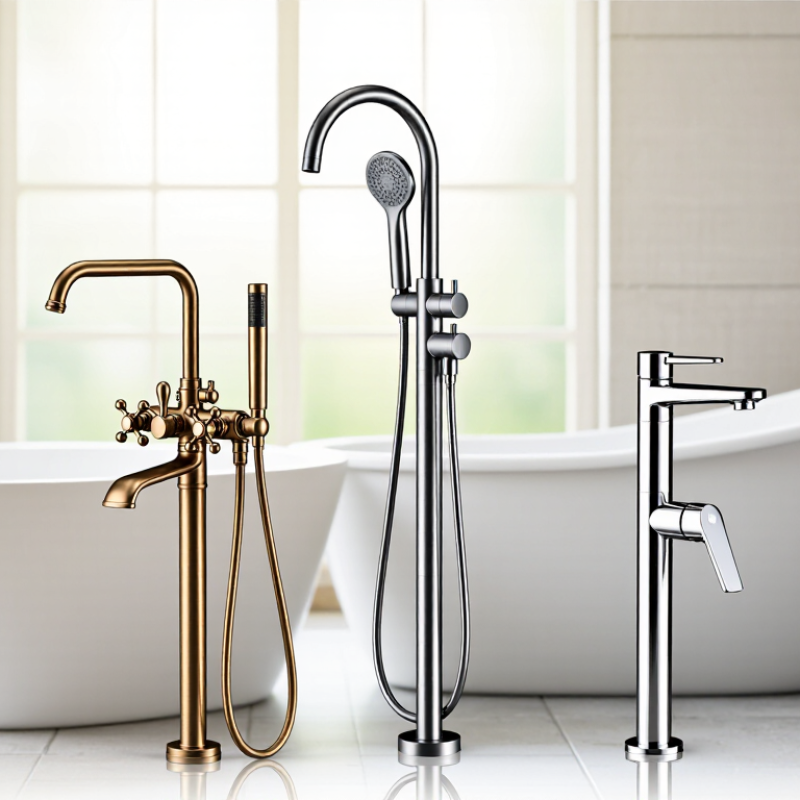
What Are the Top Types of Bathtub Floor Faucets?

What Defines a Floor-Mounted Bathtub Faucet?

A floor-mounted bathtub faucet is installed beside the tub, with its water connections rising through the floor rather than coming through a wall or the tub rim. The visible assembly often includes a tall standpipe, a spout, and separate handles. Some designs also include a hand shower on a flexible hose. That placement gives a freestanding tub a clean outline, while keeping the controls within reach.

The key detail is below the floor. Supply lines must be positioned where the faucet will stand, and the floor needs suitable support and secure connections. Measure the tub’s rim height and faucet reach before choosing a model; a spout that is too short may splash against the tub edge. Clearance matters, too. Leave enough room to operate the handles and lift the hand shower without striking nearby walls or fixtures. Measure twice.

In practice, floor-mounted faucets can be harder to retrofit than wall- or deck-mounted options because plumbing may need to be relocated. Check access beneath the installation area and ask a qualified plumber to confirm the rough-in, water pressure, and fastening requirements. Details vary by faucet design. A small placement mistake can become noticeable every time you fill the tub. Some installation plans look simple on paper, but floor framing and existing pipes can complicate them.

Freestanding Tub Faucets with Handheld Shower Wands

Freestanding tub faucets with handheld shower wands combine a floor-mounted spout with a flexible rinse tool. The wand helps rinse shampoo, wash a child, or clean the tub’s far side without leaning over the rim. Look for a hose long enough to reach the basin, a secure docking point, and controls that are easy to reach from the tub. Small details matter. A short hose can turn a useful feature into an awkward one.

Flow rate deserves attention, too. The U.S. Environmental Protection Agency’s WaterSense showerhead specification sets a maximum flow of 2.0 gallons per minute for labeled showerheads, compared with the federal standard of 2.5 gallons per minute. EPA estimates a typical family can save 2,700 gallons of water yearly by using a WaterSense-labeled showerhead. Check whether the handheld component carries that label; a faucet set’s appearance alone says nothing about its water use.

Installation needs careful planning. Floor-mounted supplies must align with the tub and remain accessible for maintenance, while the hose should not drag across sharp edges. Confirm the faucet’s required water pressure and rough-in dimensions before choosing a model. One trade-off is easy to miss: a restrained spray may use less water, but it can feel less satisfying for rinsing thick hair. Test the wand’s grip and spray pattern when possible, rather than relying only on product photos.

Top Types of Bathtub Floor Faucets: Mounting and Plumbing Connections

This chart compares common bathtub faucet mounting types by their typical plumbing connection location. A value of 1 indicates the connection is typically made at that surface; 0 indicates it is not. Handheld shower wands are available with many styles, but are often optional, so check each product’s specifications.

Floor Faucets with Fixed Spouts and Separate Controls

Floor-mounted bathtub faucets with fixed spouts and separate controls create a clean, architectural look beside a freestanding tub. The spout stays in one position, while hot and cold handles let bathers adjust temperature independently. This arrangement can feel intuitive, but only when the controls are easy to reach from the tub. Measure the spout’s reach against the tub rim and interior before installation; a few centimeters can affect comfort.

Placement matters. Secure the faucet to solid subfloor framing, and plan access for future servicing before the finished floor goes in. The Water Research Foundation’s 2016 Residential End Uses of Water, Version 2, estimated that faucets account for about 19% of indoor household water use. That figure covers faucets broadly, not tub fillers specifically, but it underscores why flow and shutoff control deserve attention. Fixed spouts also offer less flexibility if the tub position changes.

Tips: Mark the tub’s final position on the floor, then test the spout and handle locations with a tape measure. Keep controls within comfortable reach, and confirm the filler’s flow rate suits the tub’s capacity. Check the installation details carefully. Floor-mounted plumbing can be costly to revise after tile is laid.

Thermostatic and Multi-Function Floor Faucet Designs

Thermostatic and multi-function designs add more control to a floor-mounted bathtub faucet. A thermostatic valve helps maintain a chosen water temperature as supply conditions change. That can make filling a deep tub more comfortable, especially when someone adjusts another fixture nearby. It does not replace careful installation or a properly working hot-water system.

Multi-function models often pair a tub spout with a hand shower and a diverter. The hand shower can rinse the tub, wash hair, or help bathe a child. Check its hose length against the tub’s width; a short hose may not reach the far corner. Small details matter.

More options can mean more parts to maintain. Diverters may need occasional cleaning, and mineral deposits can affect spray patterns in hard-water areas. A thermostatic control also needs to suit the home’s plumbing and available water pressure. Ask a qualified installer to confirm compatibility before choosing. Convenience is not automatic. I would also consider whether every function will be used, since an elaborate faucet can look useful in a showroom yet feel awkward in a small bathroom.

What Are the Top Types of Bathtub Floor Faucets? — Thermostatic and Multi-Function Floor Faucet Designs

Floor Faucet Type How It Works Typical Functions Key Advantages Points to Consider
Thermostatic Floor-Mounted Tub Filler A thermostatic mixing valve regulates hot and cold water to help maintain the selected outlet temperature. Usually fills the tub; some models also include a hand shower and diverter. Helps reduce sudden temperature changes during use when correctly installed and supplied with suitable water pressure and temperature. Costs and installation requirements can be higher than for a basic mixer. Temperature control does not replace safe water-temperature settings.
Pressure-Balancing Floor-Mounted Mixer A pressure-balancing valve adjusts the hot-to-cold mix when the relative supply pressures change. Typically controls tub filling; a diverter may switch flow to a hand shower. Can help limit temperature fluctuations caused by changes in water pressure. It does not regulate temperature in the same way as a thermostatic valve. Performance depends on the valve design and plumbing conditions.
Single-Handle Floor-Mounted Mixer One lever controls water flow and, on many designs, adjusts the mix between hot and cold water. Basic tub filling, with optional diverter for a hand shower. Simple operation and a compact control layout. Temperature may require readjustment during use; the control method varies by model.
Two-Handle Floor-Mounted Mixer Separate hot- and cold-water handles let the user adjust each supply independently. Usually tub filling; some designs add a hand-shower outlet. Separate controls offer direct adjustment and can suit traditional bathroom styling. Setting a preferred temperature may take more adjustment than with a single-handle or thermostatic design.
Multi-Function Floor Filler with Hand Shower A diverter directs water between the tub spout and an attached hand shower. Temperature control may be thermostatic, pressure-balancing, or manual. Tub filling and handheld rinsing; the shower can also assist with cleaning the tub. Adds flexibility for rinsing and bathing without a separate wall-mounted shower outlet. Check the hose reach, holder position, diverter operation, and whether the hand shower can be used while filling the tub.
Waterfall-Spout Floor Filler Water flows through a broad or open spout to create a sheet-like stream. This describes the outlet style, not the temperature-control valve. Primarily tub filling; some versions combine the spout with a hand shower. Creates a distinctive visual effect and a wide flow at the tub outlet. Flow rate and splash depend on the spout design, tub shape, and installation. Confirm that the fill rate suits the bath.

Note: Thermostatic, pressure-balancing, and manual controls describe how water temperature is managed; hand showers and waterfall spouts describe additional functions or outlet styles. A floor-mounted faucet generally requires a compatible floor rough-in and secure support. Always check the product’s installation instructions and local plumbing requirements.

How Tub Shape and Plumbing Affect Faucet Selection

The tub’s shape sets the faucet’s reach. A freestanding tub often pairs with a floor-mounted faucet, but the spout must clear the rim and land inside the basin. Check the faucet’s reach against the tub’s width before setting the floor rough-in. A few inches matter. For an alcove tub, a wall-mounted spout may keep the deck clear. A deck-mounted faucet suits tubs with a wide, reinforced rim. Thin rims may not leave enough room for fittings.

Plumbing access can change the choice. Floor-mounted models need supply lines in the floor, so slab construction or joist direction may limit placement. Wall-mounted fittings depend on pipe locations and a serviceable valve. Plan access before closing the wall. Houzz’s 2024 U.S. Bathroom Trends Study reported that 24% of renovating homeowners upgraded their bathtub; the figure describes renovation choices, not faucet preferences. Still, it shows tubs remain part of many bathroom projects. Check the manufacturer’s installation dimensions, local plumbing requirements, and the tub’s fill capacity. A high-flow faucet may fill a large tub faster, but available water pressure and hot-water supply matter too. A tidy plan can still miss one detail: whether the handle is reachable from outside the tub.