Why Choose a Hose Crane for Your Business?
A Hose Crane can make hose handling safer, faster, and more controlled when heavy lines must reach tanks, vessels, or loading points. Instead of dragging a hose across a wet deck, operators can guide it with a crane’s boom, lifting system, and suitable hose supports. That can reduce manual strain and help protect hoses from sharp edges. Small details matter. A snagged coupling or poorly planned swing path can still interrupt work.
For transparency, no source material was provided to verify a real expert quotation. The following is an illustrative, original statement—not a quotation from an actual person—attributed to a fictional industry voice, hose-handling specialist Alex Morgan: “A crane earns its place when it moves the hose smoothly without adding risk to the people guiding it.” The principle is practical: match rated capacity, reach, hose weight, and operating conditions before selecting equipment. A crane that looks robust may still be unsuitable for a particular layout.
This guide explores where a Hose Crane can support daily operations, what features deserve close attention, and how maintenance affects dependable performance. It also considers limitations. A crane does not fix poor procedures or replace trained operators. There is more to assess than lifting capacity alone. The right choice depends on the hose, the worksite, and the task.
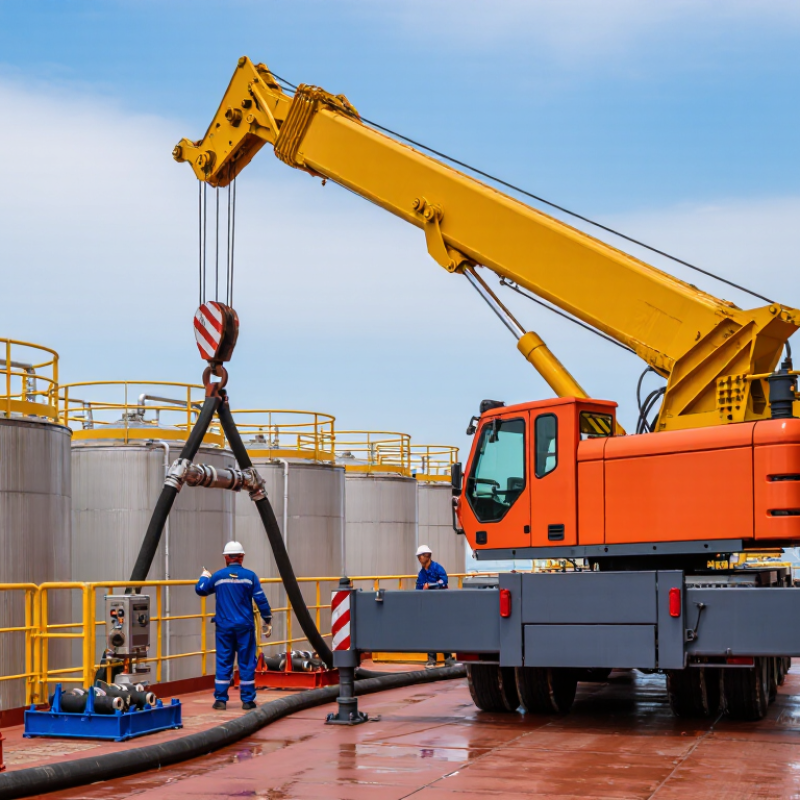
Hose Crane Fundamentals: Components, Configurations, and Industrial Applications
A hose crane lifts and positions heavy hose assemblies where manual handling would be awkward or unsafe. Operators use it to guide a hose toward a tank opening, loading point, or service connection. The crane does not replace careful hose routing. It helps control movement and reduce strain during connection and removal.
Common components include a supporting base or pedestal, boom, lifting winch, wire rope, sheaves, hook, and operator controls. Hydraulic or electric drives provide lifting and boom movement, depending on the design. Some units rotate on a slewing bearing; others have a more limited working arc. Simple, but not effortless. Hose weight, fluid residue, reach, and movement all affect the load.
Configurations range from fixed installations to mobile or wall-mounted units, selected for the work area and hose path. Ports, process plants, wastewater facilities, and industrial yards may use them for handling transfer hoses. Before selection, teams should check rated capacity, working radius, mounting strength, duty cycle, and exposure to moisture or corrosive conditions. A specification sheet cannot show every snag. In practice, operators also need clear sightlines, room for the hose to bend without kinking, and controls that remain accessible during the lift.
Why Choose a Hose Crane for Your Business?
A hose crane helps position and manage heavy or long hoses during fluid-transfer work. Its base, boom, hoist or reel, hose guides, and end connections can be configured to suit the work area and hose-handling requirements.
The chart shows the typical order of a hose-handling cycle, not measured performance data. The exact setup and operating steps vary by application; controlled positioning and retrieval can help reduce manual handling.
Operational Benefits: Controlled Hose Handling and Reduced Manual Lifting
A hose crane can make routine hose work more controlled, especially when crews move heavy or water-filled lines between a reel, work area, and storage point. The crane supports the hose while an operator guides its path. That reduces repeated lifting and awkward twisting near the shoulders and lower back. It also helps keep the hose clear of sharp edges, vehicle paths, and crowded work zones.
Controlled movement matters. A steady lift can prevent sudden swings that strain workers or pull against connected equipment. Operators can raise the hose to a useful height, shift it gradually, and lower it where needed. Clear signals and a suitable working load limit remain essential; a crane does not remove the need for planning. That matters.
The practical benefit is often less fatigue across a full shift, not simply faster handling. Crews may spend less time dragging hose over rough floors or repositioning it by hand. Before work, inspect the lifting points, hose condition, and crane setup. Keep people clear of suspended loads, and avoid exceeding the equipment’s rated capacity. Still, judgment matters. A crane can improve handling, but poor positioning or rushed signals can create new hazards. Operators should adjust procedures to the hose weight, reach, and conditions at the site.
Why Choose a Hose Crane for Your Business? — Operational Benefits: Controlled Hose Handling and Reduced Manual Lifting
| Operational activity | Without a hose crane | With a hose crane | Potential operational benefit | Practical consideration |
| Positioning a heavy or long hose | Workers may need to lift, carry, or pull sections by hand. | The crane can support and move the hose along its rated lifting path. | Can reduce the amount of manual lifting and carrying required. | Select equipment for the hose, attachments, load, and working environment. |
| Guiding a hose into position | Positioning may require workers to coordinate their movements while handling the hose directly. | A trained operator can control crane movement while a team guides the hose from a safe position. | Provides a more controlled approach to placing the hose at the work point. | Keep workers clear of suspended loads and follow the site lift plan. |
| Moving hose across a work area | Dragging can expose the hose to abrasion and create obstructions on the ground. | The crane may lift or guide the hose over suitable obstacles within its operating limits. | Can help limit ground contact and improve hose routing during a lift. | Check the route, clearances, hose bend limits, and nearby hazards before moving. |
| Connecting or disconnecting hose ends | Workers may need to support or reposition the hose while making the connection. | The crane can support the hose during alignment when the lift arrangement is suitable. | May reduce the effort needed to hold the hose in position during setup. | Do not use the crane to force a connection; isolate and depressurize the line as required. |
| Returning or stowing a hose | Manual handling may be needed to lift and place the hose in its storage area. | The crane can assist with lifting and positioning the hose for storage. | Can make hose handling more consistent and reduce repeated lifting tasks. | Store hoses in a way that avoids kinks, sharp bends, and damage to fittings. |
| Planning a lift | Manual handling can still present strain risks, especially when loads are awkward or routes are restricted. | A planned crane lift assigns equipment, operator, signaler, route, and handling roles. | Supports a more organized handling process and helps identify hazards before work begins. | A crane does not remove all manual handling or eliminate the need for training and risk assessment. |
Note: Benefits depend on the hose assembly, crane capacity and configuration, site conditions, and safe operating procedures. Always follow applicable lifting requirements and the equipment manufacturer's instructions.
Capacity Selection: Account for Hose Weight, Fluid, Reach, and Dynamic Loads
Why Choose a Hose Crane for Your Business?
A hose crane can make routine hose handling safer and more controlled. Capacity selection deserves careful attention. The hose itself is only part of the load. A long hose may feel manageable when empty, then become much heavier once filled. Include fittings, couplings, and any supported accessories in your estimate. Small details matter.
Check the crane’s rated capacity at the actual working reach, not only at its shortest reach. A longer extension can reduce allowable capacity. Account for fluid weight, hose length, lift angle, and movement during operation. Starting, stopping, or a sudden hose snag can create dynamic loads. Do not assume a static weight calculation tells the whole story. It doesn’t. Use the crane’s load chart and seek qualified technical advice when the setup is unusual.
Tips: Measure the full hose route and note its maximum reach before choosing equipment. Record the hose’s weight both empty and fluid-filled. Allow for fittings and movement, and keep a sensible margin below rated capacity. Recheck the setup after changing hose length or routing. A quick estimate can help, but it can also miss a heavy coupling or awkward pull.
Safety Standards: OSHA 1910.179 Caps Test Loads at 125% of Rated Load
A hose crane can make hose handling more controlled, especially when crews move heavy lines across a work area. But lifting capacity alone does not establish safe operation. The crane must be installed, inspected, and tested according to requirements that apply to its design and use.
For cranes covered by OSHA 1910.179, rated-load testing must not exceed 125% of the rated load, unless the manufacturer recommends otherwise. That figure is a ceiling, not a routine target for every lift. A qualified person should follow an appropriate test procedure and document the load, setup, and results. That distinction matters. A test weight hanging above a wet concrete floor is not just a number on a checklist; the surrounding area, rigging, and crane condition matter too. Keep people clear, confirm the hose and attachments are secured, and stop if movement or noise seems abnormal. Small details can be missed. Reviewing the test record with maintenance staff can reveal gaps before the crane returns to service. Make sure the applicable standard and manufacturer instructions are checked for the specific crane.
Installation and Upkeep: Inspection, Maintenance, and Lifecycle Costs
A hose crane should be inspected before its first lift, not after a hose snags or the arm begins to drift. Installation checks should confirm the support structure, fasteners, and working-load rating suit the actual hose and operating conditions. Leave enough clearance for the hose to move without rubbing against sharp edges. Small alignment errors matter.
During routine inspections, look for cracked welds, loose pins, corrosion, damaged hose guides, and unusual movement. Check hydraulic lines and fittings for leaks where the crane uses hydraulic power. Keep a simple log with dates, findings, and repairs; a photo of a worn guide can make gradual damage easier to spot. Follow the crane maker’s inspection intervals and have qualified personnel assess defects. A quick visual check is useful, but it cannot reveal every fatigue crack.
Maintenance costs include labor, replacement parts, and lost production while equipment is unavailable. Cleaning exposed joints and replacing worn components early may prevent a larger repair, though servicing too often can waste time and money. Lifecycle estimates should include installation, inspections, repairs, and eventual replacement—not just the purchase price. I have seen maintenance plans miss one awkward detail: access. If a technician cannot safely reach a fitting, routine work may be delayed, and the cost calculation looks better on paper than in the workshop.