What Is a Single Acting Hydraulic Cylinder?
A Single Acting Hydraulic Cylinder uses pressurized fluid to produce force in one direction. Hydraulic oil enters one side of the piston, extending the rod and moving a load. Retraction happens differently: a spring, gravity, or an external force returns the piston. That distinction shapes the cylinder’s design, installation, and operating limits.
The principle is simple. The details are not. A cylinder’s bore, stroke, pressure rating, mounting style, seals, and fluid compatibility must suit the machine. In a dump trailer, for example, hydraulic pressure raises the bed, while gravity may lower it. In a compact press, a spring may provide the return stroke. Each arrangement needs careful assessment; gravity return can be unreliable when loads or mounting angles change.
Market reports show why hydraulic actuators remain relevant in industrial equipment. Grand View Research’s Hydraulic Cylinder Market Size, Share & Trends Analysis Report estimated the global market at USD 14.76 billion in 2023 and projected a 4.3% compound annual growth rate from 2024 to 2030. These figures describe market estimates, not a guarantee that one cylinder type fits every application. ISO 4413:2010 also sets general safety requirements for hydraulic fluid power systems, underscoring the need to consider pressure hazards and system design. Still, a basic question deserves scrutiny: is a single-acting design truly simpler for the whole machine, or only for the cylinder itself? This guide explains its operation, main components, common uses, benefits, and limitations. Short answer: one powered direction.
Definition and Basic Design of a Single-Acting Hydraulic Cylinder
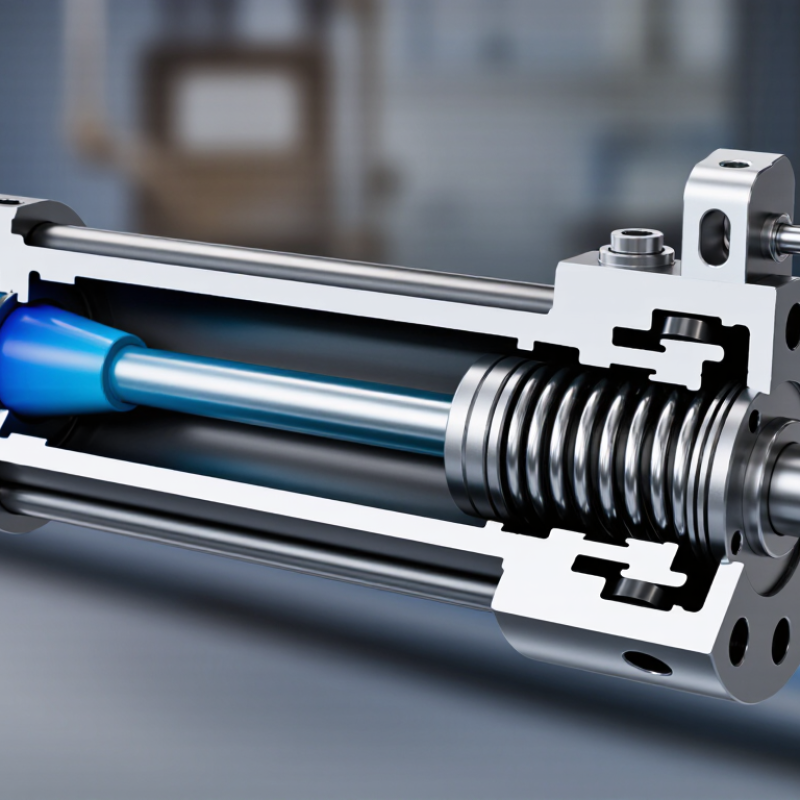
A single-acting hydraulic cylinder uses pressurized fluid to produce force in one direction. Fluid enters through a port and pushes against a piston inside a sealed barrel. The piston moves the attached rod outward, creating linear motion for lifting, pushing, or clamping. The basic design is direct. It is not effortless.
A typical cylinder contains a barrel, piston, rod, seals, end caps, and one hydraulic port. The seals limit fluid leakage as the piston travels, while the rod transfers force to the machine or load. On the opposite side of the piston, air must usually enter or leave through a vent. If that space is blocked, movement can become slow or uneven.
The return stroke needs another force. A spring may pull the rod back, or gravity and the supported load may do the work. This changes how the cylinder should be mounted and operated. For example, a vertical lifting cylinder may lower under the load’s weight, but only when the system allows controlled fluid release. The drawing looks simple. Real installations are less tidy: friction, side loads, seal wear, and trapped air can affect motion. A sensible design accounts for these details, not just the cylinder’s advertised force.
Key Components and Their Functions
A single-acting hydraulic cylinder uses pressurized fluid to move its piston in one direction. The cylinder barrel contains the piston, while the piston rod transfers force to the machine. At the cylinder head, a rod seal limits fluid leakage and a wiper removes dust from the rod as it retracts. Inside, piston seals separate pressure from the opposite chamber. One small seal can matter.
Fluid enters through a single port and pushes against the piston face. Retraction usually depends on an external load, gravity, or an internal spring; the design determines which. ISO 6020-1:2018 specifies mounting dimensions for a 16 MPa (160 bar) cylinder series, but the actual cylinder’s rating must still be checked. The U.S. Department of Energy’s 2006 Improving Pumping System Performance sourcebook estimates that pumping systems use nearly 20% of global electricity. That figure covers pumping systems broadly, not cylinders alone, but it highlights the value of avoiding wasted flow. Seal wear, misalignment, or contamination can undermine performance. In practice, these details are easy to overlook.
What Is a Single Acting Hydraulic Cylinder? - Key Components and Their Functions
| Component |
Main Function |
How It Works |
Key Notes |
| Cylinder barrel |
Contains the hydraulic pressure and guides the piston. |
The piston moves along the barrel bore as pressurized fluid enters the cylinder. |
The bore surface needs to be smooth and accurately sized to support sealing and piston movement. |
| Piston |
Separates the pressure chamber from the other side of the cylinder and transfers force to the piston rod. |
Hydraulic pressure acting on the piston creates linear force. |
Its effective area, together with fluid pressure, determines the cylinder’s theoretical force. |
| Piston rod |
Transfers force and motion between the piston and the external load. |
The rod moves through the cylinder head as the piston travels. |
Rod size and unsupported length affect strength and resistance to buckling. |
| Rod head or gland |
Supports and guides the piston rod where it exits the barrel. |
It houses the rod seal and often a bearing or guide ring. |
Many designs allow the gland to be removed for seal servicing. |
| Seals |
Limit hydraulic-fluid leakage and help maintain pressure. |
Piston seals reduce fluid bypass across the piston; rod seals help prevent fluid escaping along the rod. |
Seal materials and profiles must suit the fluid, pressure, temperature, and operating conditions. |
| Wiper or rod scraper |
Helps keep dirt and moisture from entering the cylinder around the rod. |
The wiper contacts the rod as it moves in and out of the cylinder. |
It complements the rod seal but is not a substitute for it. |
| Hydraulic port |
Provides the connection through which pressurized fluid enters and leaves the cylinder. |
In a typical single acting cylinder, one port supplies fluid to the pressure chamber; fluid returns through the same port. |
Port size and connection type must match the hydraulic circuit and required flow. |
| Base or end cap |
Closes the barrel end opposite the rod and helps contain pressure. |
It may also provide a mounting point or connection to the machine. |
Construction and mounting details vary by cylinder design. |
| Return mechanism |
Moves the piston and rod back when hydraulic pressure is released. |
Return force may come from an external load, gravity, or a built-in spring. |
A spring return is one design option; not every single acting cylinder contains a spring. |
| Single acting operation |
Produces powered movement in one direction. |
Fluid pressure drives the piston in the working direction. When pressure is released, the return mechanism moves it back. |
The cylinder’s orientation and load must allow the intended return method to work safely. |
How a Single-Acting Hydraulic Cylinder Operates
What Is a Single Acting Hydraulic Cylinder?
How a Single-Acting Hydraulic Cylinder Operates
A single-acting hydraulic cylinder uses fluid pressure to move its piston in one direction. The pump sends oil through a control valve into the cylinder’s pressure port. As oil fills the chamber, pressure pushes the piston forward and extends the rod. The load may be a lift table, a compact press, or a machine guard. Motion feels steady. But only when flow and load are matched. The opposite chamber is usually vented, allowing air to move freely as the piston travels.
When the valve releases pressure, the cylinder does not usually pull itself back. A spring, gravity, or the machine’s load returns the piston and rod. For example, a vertical platform can descend under its own weight while oil flows back to the reservoir. A spring-return model behaves differently; its spring must overcome friction and any remaining load. Sizing matters. Too little return force can leave the rod partly extended, a detail easy to miss during a quick test. Check the return path, mounting alignment, and rated pressure before operation. Pressure can remain trapped after the pump stops, so release it before inspection. This is easy to overlook when a cylinder appears to be at rest.
What Is a Single-Acting Hydraulic Cylinder?
A single-acting cylinder uses hydraulic pressure to extend its piston rod. A spring, gravity, or an external load returns the rod, so hydraulic fluid acts on only one side of the piston.
How to read the chart: For a 50 mm bore, theoretical extension force rises with pressure. Actual force may be lower because of friction and other system losses.
Common Types and Applications
What Is a Single Acting Hydraulic Cylinder? Common Types and Applications
A single-acting hydraulic cylinder uses pressurized oil to move its rod in one direction. A load, gravity, or a spring provides the return force. Simple in design, it works well when the powered stroke does the lifting, pushing, or tipping. The return stroke still needs careful planning.
Common types include ram or plunger cylinders, which suit heavy pushing and lifting, and telescopic cylinders, whose nested stages provide a long stroke in a compact space. You’ll find them on dump bodies, agricultural implements, lifting platforms, and hydraulic jacks. Grand View Research valued the global hydraulic equipment market at $39.63 billion in 2023 and projected 4.6% annual growth through 2030. That figure covers more than cylinders, but it reflects the wider equipment market these components serve.
Tips: Check the load’s return path, mounting points, and required stroke before selecting a cylinder. A cylinder may lift smoothly yet return slowly if the load is too light. That detail is easy to overlook.
Advantages, Limitations, and Maintenance Considerations
A single-acting hydraulic cylinder uses pressure to move its piston in one direction; a spring, gravity, or an external load returns it. Fewer powered components can mean simpler plumbing and lower initial cost. On a lift table, the hose and cylinder are easy to trace. Less hardware helps. But the return force must be dependable. A spring-return design gives up some space to the spring, while gravity return depends on the cylinder’s orientation and load.
Its advantage is simplicity, not universal efficiency. The cylinder cannot actively control its return, and a suspended load may descend if a valve or line fails. Use suitable load-holding and lowering controls based on the machine’s risk assessment. A restricted return path can also slow the cycle. Designers sometimes assume “down” is always available. It isn’t.
Maintenance centers on fluid cleanliness, seals, alignment, and leaks. ISO 4406:2021 classifies hydraulic-fluid contamination using particle counts above 4, 6, and 14 μm(c). Follow the equipment’s specified cleanliness target; clear-looking oil is not proof of clean oil. Inspect the rod for scoring, remove grit before it reaches the seal, and check for uneven wear that may indicate side loading. A thin oil film may be normal. A growing wet ring is not. Record leakage and cycle speed; missed notes can hide a developing fault.